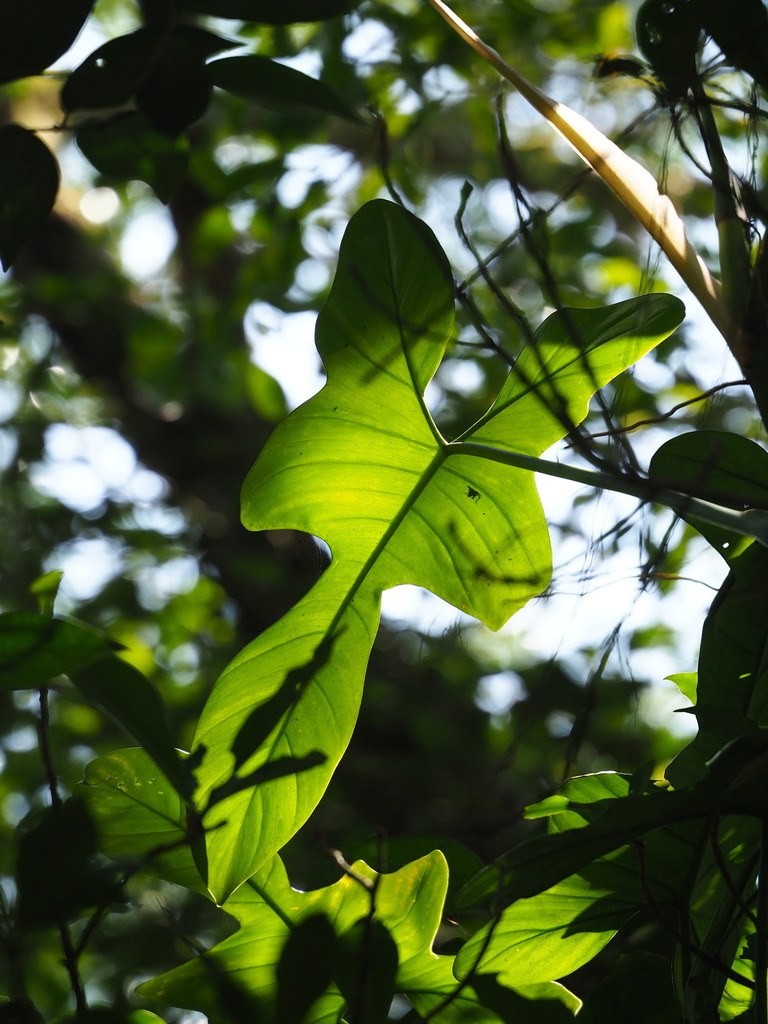
📷 no rights reserved / iNaturalist (CC0)
Field Guide · Philodendron
The horse-head philodendron is a forgiving climber that rewards a stout pole with leaves that genuinely change shape as the plant matures.
The baseline plant and still the best version for most growers. Juvenile leaves are simple and arrow-shaped; once climbing, they develop the five-lobed, horse-head silhouette that earned it the common name. Glossy mid-green, fast on a moss pole, and tolerant of household humidity in the 55–65% range. If you've never grown a maturing climber, start here.
Best overallA pale, almost glaucous form whose new leaves push out yellow-green and harden to a cool olive. The lobing is more pronounced than the straight species and the petioles take on a faint purple cast in bright light. Slower than green bipennifolium and slightly fussier about light — too dim and the color muddies. Worth the patience for the color contrast in a mixed collection.
Collector pickA stable speckled-variegated cultivar with cream and pale-green flecks scattered across the lamina. Variegation is sectorial and unpredictable, so prune to the most marked node if you want to push pattern. Care is identical to the species but give it slightly brighter light to hold contrast. Less expensive than mint or albo-variegated philodendrons and easier to keep clean.
Variegated valueOften confused with bipennifolium and frequently sold under its name, but a distinct species with deeper, more finger-like lobing and a thinner leaf. Useful as a comparison plant — grown side by side, the differences in lobe depth and leaf substance become obvious. Care is essentially the same. Buy from a seller who labels carefully.
Frequently confused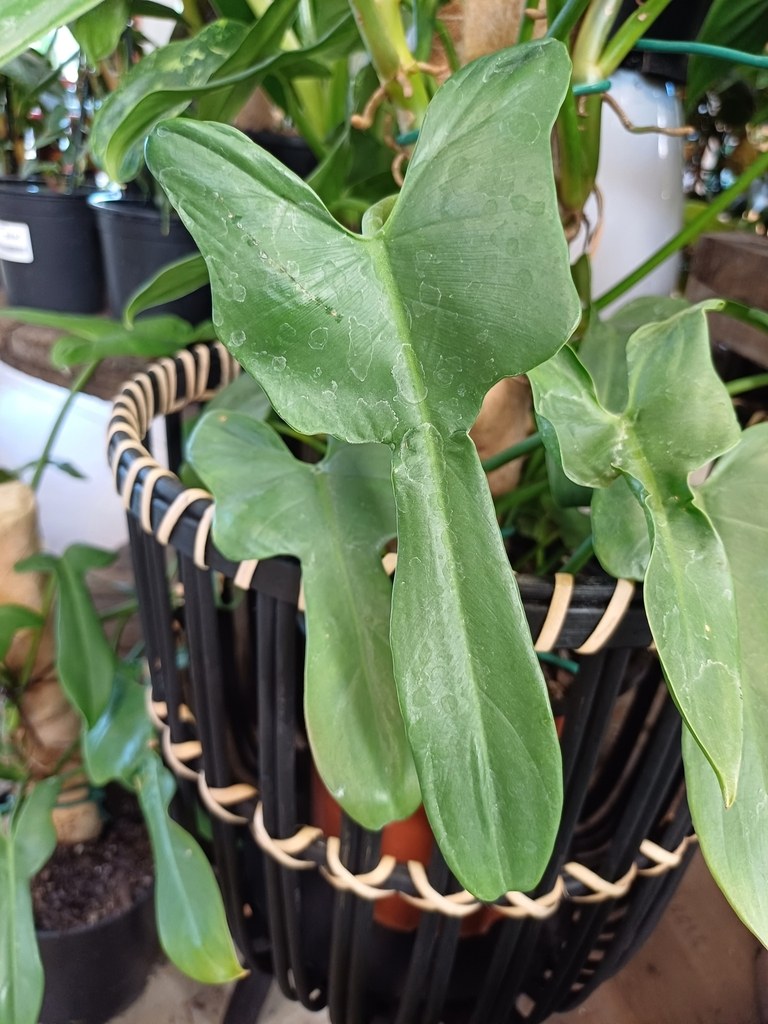
Philodendron bipennifolium is one of the more honest climbers in the genus. It does what the textbook says: juvenile leaves stay simple and entire until the plant feels a vertical surface, and then — usually within a year of mounting — it begins producing the lobed, fiddle-shaped foliage that gives it both common names (fiddleleaf and horse-head philodendron). Watching that shift happen in a living room is most of the appeal.
Native to humid lowland forest from southeastern Brazil up through parts of Paraguay and northern Argentina, it's a hemiepiphyte: it germinates on the ground, finds a tree, and climbs. In cultivation that means it sulks as a tabletop plant and accelerates the moment you give it something to grip. A 24- to 36-inch moss pole, sphagnum-wrapped and kept damp, is the difference between a passable houseplant and a plant that actually shows you what it can do.
It's also forgiving by aroid standards. It doesn't demand the 80% humidity that velvet philodendrons want, it isn't prone to the bacterial collapse that haunts gloriosum in wet substrate, and it grows fast enough that mistakes are recoverable. For a collector graduating from heartleaf philodendrons toward harder species, it's the right next step.
Substrate. Build a chunky aroid mix: roughly 40% orchid bark, 30% coco chips or coir, 20% perlite or pumice, and 10% worm castings or composted bark fines. The mix should hold a closed fist together briefly and then crumble. Anything that stays sodden for more than two or three days is wrong for this plant.
Light. Bright indirect is the working answer — an east window, a few feet back from a south or west window, or under a horticultural light running 12 hours at around 150–250 µmol PPFD at leaf height. Direct midday sun will bleach new leaves to a pale yellow that doesn't recover. Too little light and the plant keeps making juvenile, unlobed foliage indefinitely.
Water and humidity. Water when the top inch of mix is dry and the pole begins to feel light; in a chunky mix that's usually every 5–9 days indoors. Let water run through the pot fully and drain. Humidity above 55% keeps leaves supple and edges clean; below 45% you'll see crisping at the sinuses where lobes meet. A small clip fan on low, aimed past the plant rather than at it, will do more for leaf quality than another humidifier.
The most frequent failure is growing it flat. Without a pole, bipennifolium stays in juvenile form, throws thinner stems, and eventually flops. Mount it early — even a young four-leaf plant benefits from a short pole it can grow into.
The second is overpotting. This is a climber, not a tuber; it wants a snug root ball and a tall support, not a wide nursery pot full of wet mix. Pot up one size at a time, and only when roots are circling the drainage holes.
Finally, mislabeling. P. bipennifolium, P. pedatum, and a handful of regional forms get traded interchangeably, and a plant sold as 'Golden Violin' may be any of several chartreuse-flushing philodendrons. Buy from sellers who show mature, climbing leaves rather than juvenile cuttings, and ask where their stock originated.
The Field Guide from Leaf People.