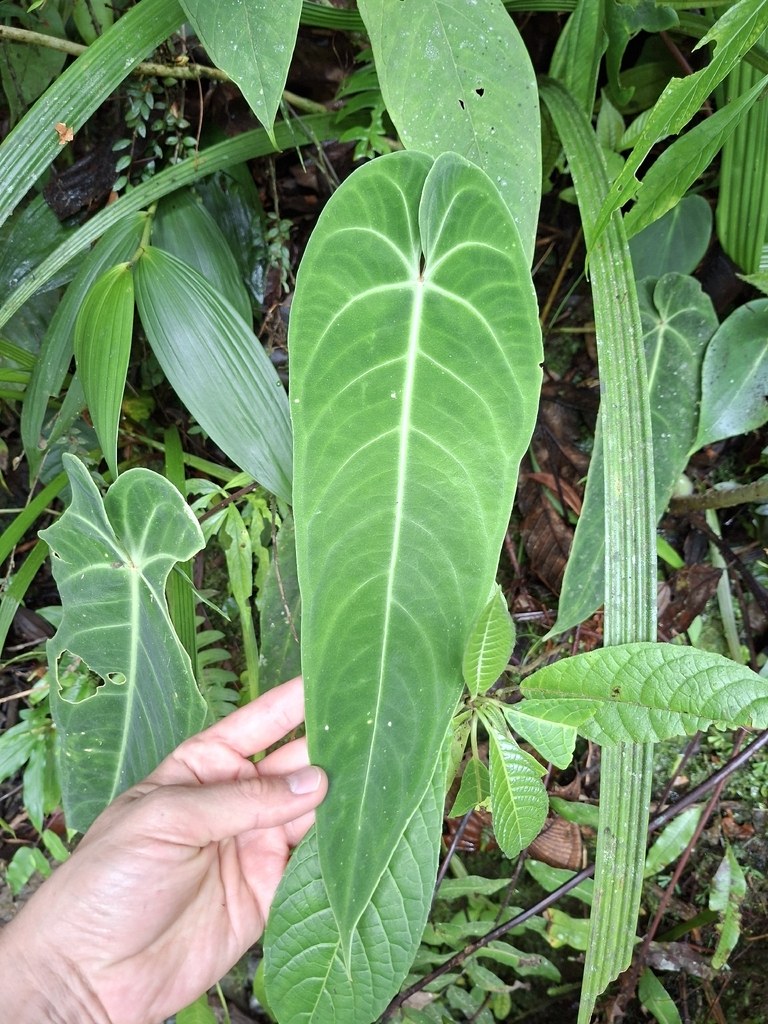
📷 Daniel Mesa / iNaturalist (CC BY 4.0)
Field Guide · Anthurium
A cross between the Queen and the square-petioled velvet — easier than either parent, but only if you respect what both of them want.
The hybrid splits the difference between its parents and is, by most growers' accounts, more forgiving than either. Leaves are broad and elongating, deep matte green with crisp silver-white venation, and the petiole shows partial squaring inherited from magnificum. It pushes leaves faster than a pure Queen and tolerates slightly lower humidity. The most balanced velvet anthurium a serious hobbyist can keep without a sealed grow tent.
Top pickThe Queen Anthurium, from cloud forests of Colombia, grows leaves a meter long on mature specimens. Velvet texture, lance-shaped blade, and a narrow rounded petiole. Notoriously slow and humidity-hungry — drop below 70% and new leaves emerge stunted or torn. Worth growing once you've proven you can hold conditions steady.
The parent benchmarkNative to Colombia's Chocó, magnificum has rounder, more cordate leaves than its sibling crystallinum, with broader silver veins and the distinctive squared, winged petiole that telegraphs the species at a glance. Faster and sturdier than warocqueanum, it tolerates 60% humidity if airflow is good. Often confused with crystallinum in trade; check the petiole cross-section.
Sturdier parentA regional selection of magnificum with larger leaves, heavier substance, and more pronounced silver venation. Habit is similar to the type but it scales up impressively under good conditions — mature leaves push past 60 cm. A reasonable alternative if the hybrid is unavailable or out of budget.
Scaled-up formSmaller and faster than the others on this list, crystallinum is the gateway velvet anthurium and a useful proving ground before committing to the hybrid. Leaves emerge bronze and harden to deep green with bright silver veins. Round petiole, no wings — that's how you separate it from magnificum in person.
Practice plant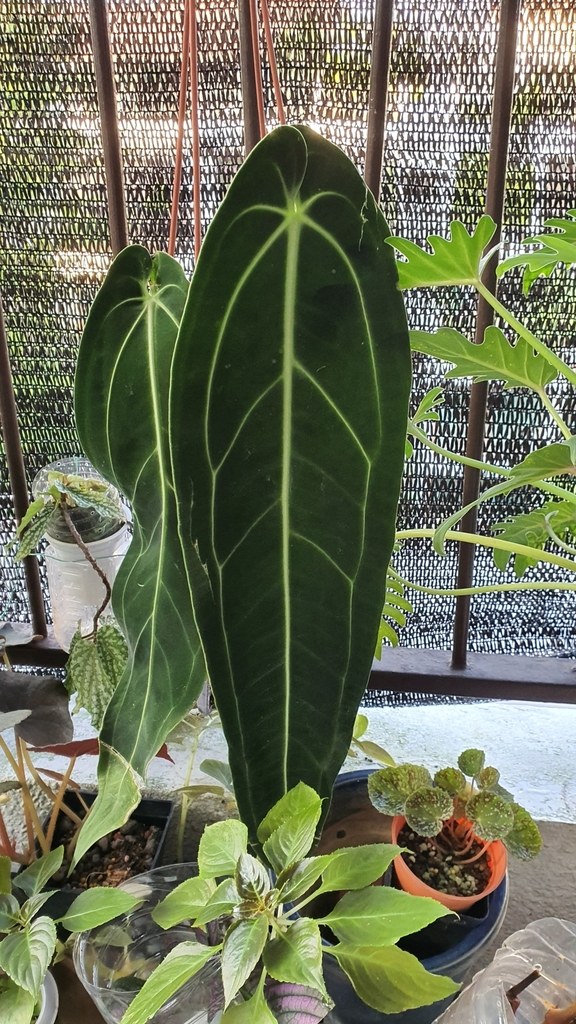
The cross was made to combine the long, dramatic blade of warocqueanum with the vigor and broader tolerance of magnificum. In practice the hybrid keeps the velvet texture and silver venation of both parents, throws leaves at roughly the pace of magnificum, and forgives short humidity dips that would scar a pure Queen. It is not, however, a houseplant in the casual sense. Treat it like a cloud forest epiphyte that happens to root in chunky media.
Mature plants in cultivation produce leaves 40–70 cm long on pendant petioles, with the squared cross-section from magnificum showing variably across seedlings. Expect a new leaf every four to six weeks in a well-run setup, slower in winter. Provenance matters: seed-grown F1 crosses vary, and a tissue-cultured clone of a known mother plant will give you predictable results.
Substrate should be aggressively airy. A working mix is roughly 40% medium orchid bark, 20% perlite or pumice, 20% coco chips, 10% horticultural charcoal, and 10% sphagnum to hold moisture at the root zone. The goal is a mix that drains in seconds and dries from the top down within three or four days. Soggy, compacted media is the single most common killer of velvet anthuriums — roots rot before you see anything wrong with the leaves.
Light is bright indirect, 150–250 µmol/m²/s at the leaf, or roughly a north-facing window with sheer diffusion, or a grow light held well above the canopy. Direct sun bleaches the velvet finish within a day and burns through the cuticle within a week. Too little light and the plant stalls, pushes thin leaves, and becomes vulnerable to root issues because it can't transpire.
Water when the top third of the pot has dried — usually every five to eight days in a chunky mix, depending on pot size and ambient humidity. Use rainwater, RO, or filtered water; anthuriums are sensitive to dissolved salts and chlorine, and velvet leaves show mineral spotting faster than glossy species. Fertilize lightly and continuously: quarter-strength balanced liquid feed at every watering beats monthly heavy doses.
Humidity is where most collectors lose this plant. Stable 70–80% gives clean, full-sized leaves; 60% is the working floor and produces smaller blades with occasional edge crisp. Below 50% new leaves emerge deformed, stick in the cataphyll, or tear as they unfurl. A grow tent or IKEA cabinet with a humidifier and a small clip fan is more reliable than misting, which does nothing measurable for ambient RH.
Airflow is non-negotiable. Stagnant high-humidity air invites bacterial blight (Xanthomonas), which presents as water-soaked black lesions that spread along veins and end the plant in days. A gentle, continuous air exchange — a small fan on low, oscillating across the canopy — prevents most foliar pathogens and strengthens petioles so leaves don't flop.
The recurring mistakes: potting in peat-heavy aroid mix that stays wet, watering on a schedule rather than by feel, running humidity high without airflow, and moving the plant repeatedly. Velvet anthuriums acclimate slowly. Pick a spot with the right light and humidity and leave it there. If a new leaf emerges smaller than the last, something in the environment dropped — usually humidity, sometimes root health — and the plant is telling you before symptoms become visible.
The Field Guide from Leaf People.