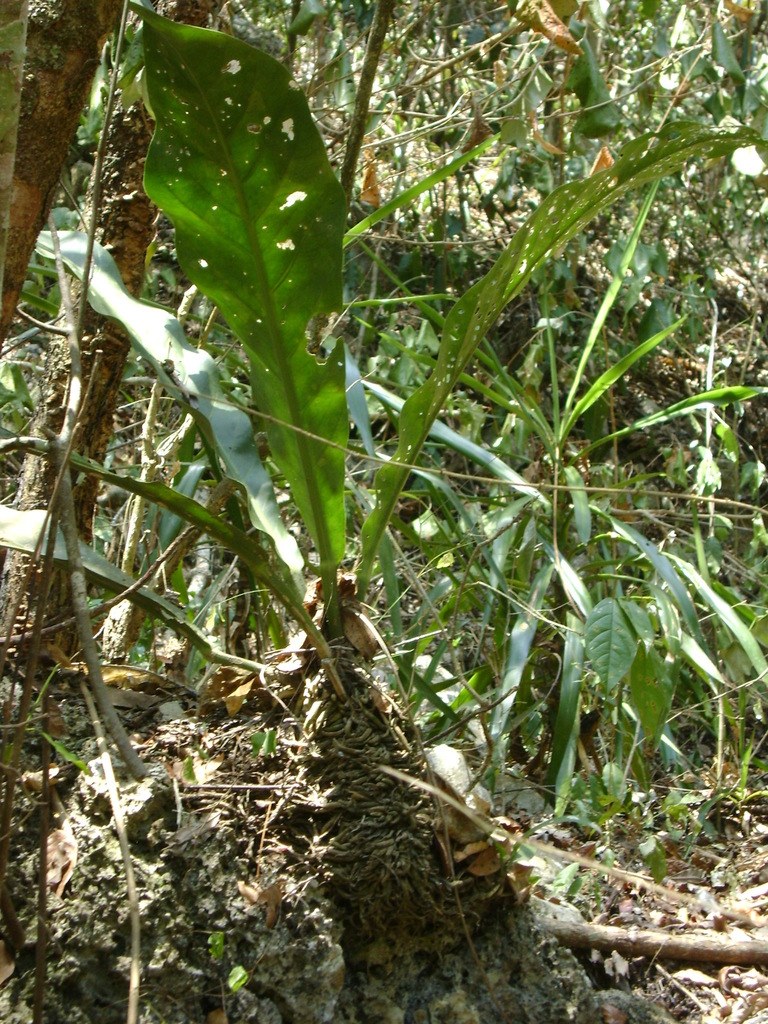
📷 Tereso Hernández Morales / iNaturalist (CC BY 4.0)
Field Guide · Anthurium
The largest of the bird's-nest anthuriums grows leaves longer than a person is tall and asks for surprisingly little in return.
The headline plant: a Central American giant ranging from southern Mexico through Panama, often growing terrestrially on limestone or epiphytically on big branches. Mature rosettes hold strap-shaped leaves three to six feet long arranged in a tight funnel that catches leaf litter. The inflorescence is unshowy — a green spathe and a purple-tinged spadix that ripens to magenta berries. It is the most forgiving large anthurium you can grow and the one most likely to actually fit through your doorway after a year.
The giantThe Caribbean bird's-nest, often confused with schlechtendalii in the trade and frequently mislabeled. Leaves are shorter and broader, with characteristic black pinpoint glands along the margins — the easiest ID feature in hand. White berries distinguish it from the red-to-purple fruits of schlechtendalii. A good choice if you want the bird's-nest silhouette without the eventual room-eating scale.
Best ID twinAn Ecuadorian bird's-nest with stiff, upright, near-vertical leaves and a strong coppery flush on new growth that hardens to deep matte green. The undersides are reddish-purple, which reads beautifully when the plant is lit from the side. Smaller in cultivation than schlechtendalii — typically three feet across — and tolerant of slightly drier air. The most architectural of the group.
Most sculpturalThe wavy-edged bird's-nest from Bolivia, Brazil, Paraguay, and Peru, with thick, leathery leaves that ripple along the margin. Tolerates more light and more neglect than the others on this list and will sit happily on a covered porch through a humid summer. Mature plants throw offsets readily, so a single specimen turns into a clump. Often sold as 'Fruffles' when the ruffling is extreme.
Most forgivingA smaller bird's-nest from the Guiana Shield with rounded, paddle-shaped leaves and a tidy habit that suits a shelf rather than a floor. Popular in Southeast Asian collections, where hybrids with hookeri and plowmanii have produced some of the more interesting ruffled cultivars on the market. Slower than plowmanii but holds its shape better in lower light. A good gateway to the bird's-nest group if you don't have the square footage for a giant.
Best for shelves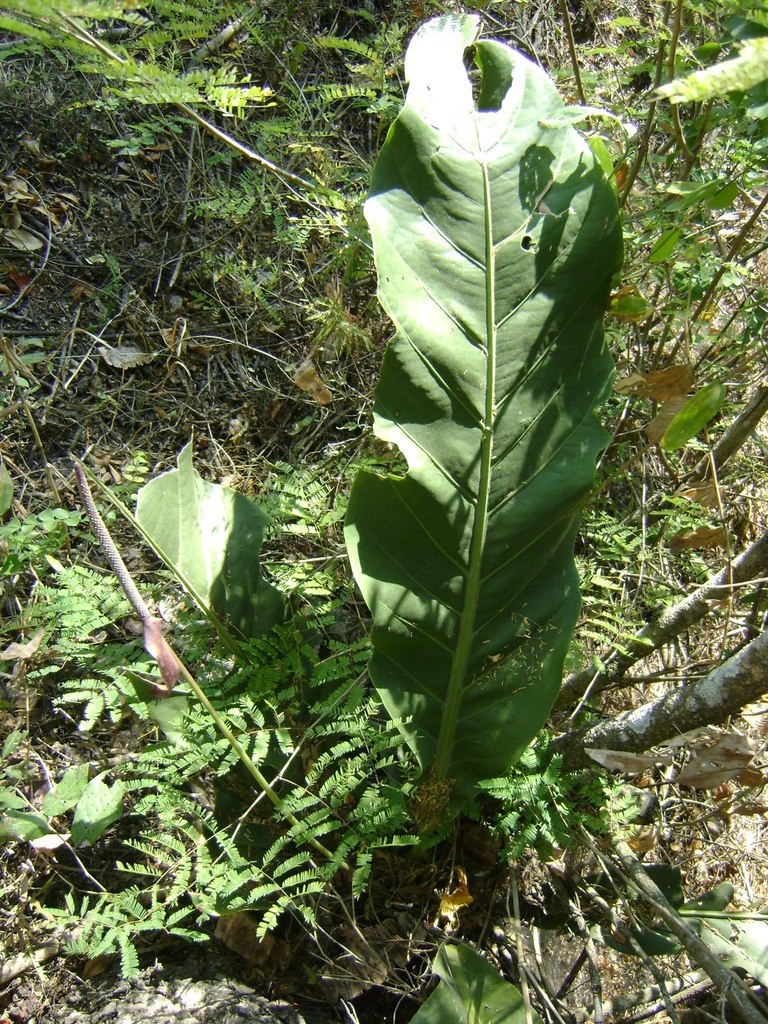
Anthurium schlechtendalii is often called terrestrial, but in the wild it routinely grows on limestone outcrops and in the crotches of large trees with almost no soil — just leaf litter caught in its own funnel. Translate that to a chunky, airy mix: roughly equal parts orchid bark, perlite or pumice, and coco chips, with a handful of charcoal and a small fraction of a peat- or coir-based component to hold a little moisture. Straight potting soil will rot the thick, fleshy roots within a season.
Pot choice matters more than it does for a thin-rooted philodendron. The root system is heavy, ropy, and water-storing, so a deep nursery pot with strong drainage beats a shallow decorative one. Mature plants happily live in the same container for three or four years; repot when roots are escaping the drainage holes or the mix has broken down to fines.
Bright indirect light is the target — an east window, a few feet back from a south or west window, or under decent grow lights at around 150–250 µmol·m⁻²·s⁻¹. Direct midday sun will bleach the leaves to a sickly chartreuse and scorch the tips, but too little light produces floppy, undersized rosettes that never form the classic funnel. If new leaves come in smaller than the previous ones, the plant wants more light.
Water thoroughly, then let the top inch or two of the mix dry before watering again. The thick roots resent constantly wet feet but also resent true drought — leaves yellow from the outside in when chronically underwatered. Humidity above 60% gives the cleanest leaves, but schlechtendalii is the most tolerant bird's-nest of dry indoor air and will hold together at 45–50% with good airflow. A small fan in the room does more for leaf quality than a humidifier alone.
The first mistake is buying one without measuring the space. A happy schlechtendalii in a 14-inch pot will throw leaves six feet long within a few years, and the rosette can easily span eight feet across. This is a plant for a corner with ceiling clearance, not a plant stand.
The second is overpotting. Collectors used to thirsty monsteras assume a big anthurium needs a big pot — it does not. Roots want air around them, and a pot only slightly larger than the existing root mass will encourage faster, healthier growth than jumping up three sizes.
The third is mistaking the inflorescence for a problem. Schlechtendalii blooms freely once mature, and the green spathe with its dark spadix is easy to mistake for a deformed new leaf or a pest gall. Leave it alone; the magenta berries that follow are part of the plant's appeal and a useful ID feature.
The Field Guide from Leaf People.