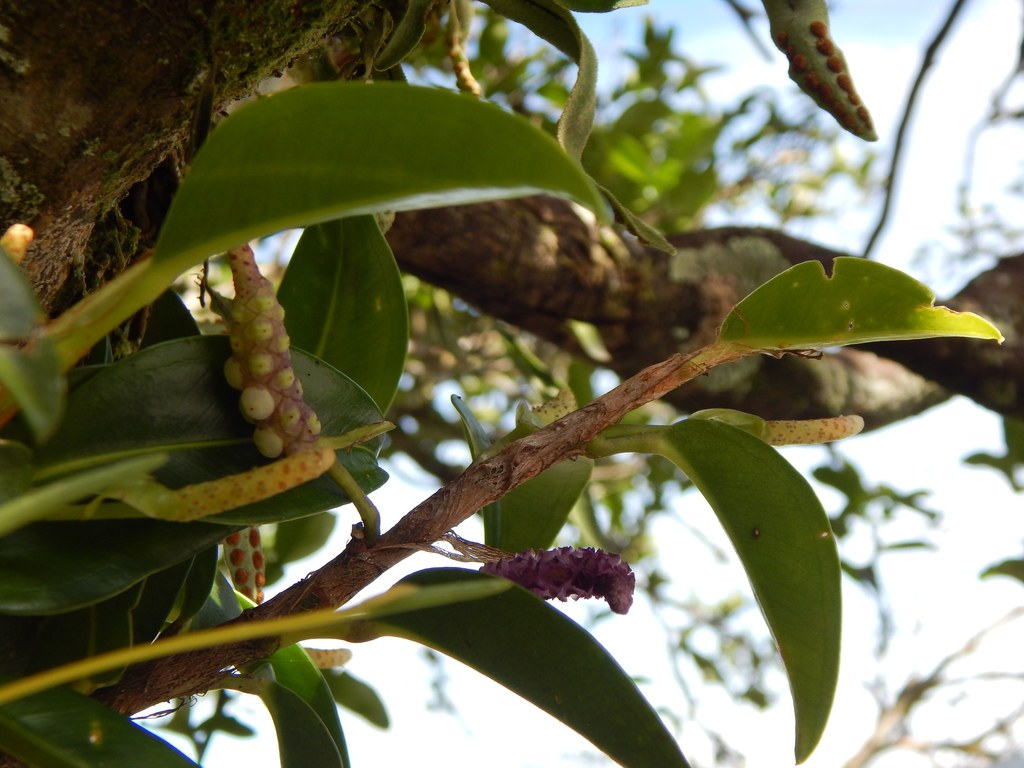
📷 Letizia Weichgrebe / iNaturalist (CC BY 4.0)
Field Guide · Anthurium
A scrambling neotropical epiphyte grown less for foliage than for the milky, almost luminous berries it carries along its stem.
The wide-ranging form, found from southern Mexico down through Brazil and the Antilles. Leaves are lanceolate to elliptic, 6–15 cm long, leathery, and a flat mid-green. The reward is the infructescence: short spadices that swell into clusters of pale, translucent berries reading nearly white in good light. It climbs willingly on bark slabs and tolerates more neglect than most Anthurium.
The classicA miniature form with shorter internodes and smaller, often more rounded leaves rarely exceeding 8 cm. It fruits readily at a manageable size, making it the right pick for a Wardian case or a crowded shelf. Growth is slow but steady under stable humidity, and mature specimens can carry berries year-round. Treat it as a true mini and avoid burying the rhizome in dense mix.
Best for casesAn informal trade designation for plants that fruit with a distinct lilac to violet cast rather than the usual milky white. Leaf shape matches the type, but new growth often flushes faintly bronze. Berry color is strongest under bright, diffuse light and cooler nights. Provenance varies wildly in the trade, so buy from a grower who has fruited the plant themselves.
Collector pickOccasionally offered by specialty nurseries, this cross brings the strappier foliage of A. bakeri to the scrambling habit and berry display of scandens. Plants tend to be more vigorous and forgiving of lower humidity than either parent. Berries lean orange-red rather than white. Worth grabbing when you see one, but verify the cross — many bakeri-types are mislabeled.
Vigorous grower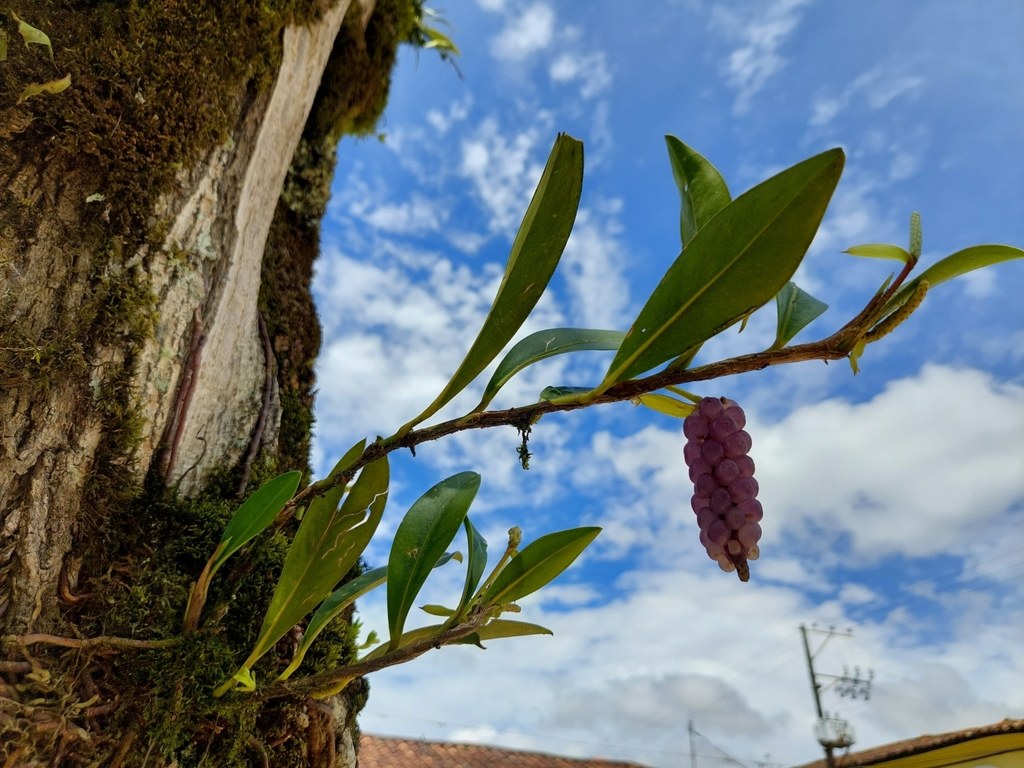
. Anthurium scandens is a true epiphyte. In habitat it grows on tree trunks and lower branches from sea level to about 2,500 m, roots wrapped in moss and leaf litter, never in soil. Replicate that or it will sulk.
The two reliable approaches are a chunky aroid mix in a small net pot, or a mount. For potted plants, blend roughly 50% medium orchid bark, 25% perlite or pumice, and 25% long-fiber sphagnum, with a handful of horticultural charcoal. The mix should drain in seconds and stay barely damp, never sodden. Repot only when the medium breaks down — usually every 18–24 months.
Mounting on cork bark, tree fern, or a sphagnum-wrapped slab suits this species better than almost any container. Lash the rhizome to the mount with fishing line or coated wire, pack a thin pad of sphagnum behind the roots, and let it climb. Mounted plants need watering more often but fruit more reliably, and the berries hang cleanly off the stem where you can see them.
Bright, diffuse light. Think the kind of dappled shade you'd find a meter inside a forest edge: 150–300 µmol/m²/s if you measure, or an east window with a sheer, or a few inches under a mid-output LED. Direct sun bleaches the leaves to a sickly yellow-green within days. Too dim and the plant survives but never fruits, which is the whole point.
Water when the medium is just shy of dry. For mounts, that often means a daily misting plus a thorough soak two or three times a week; for pots, a deep watering every 5–10 days depending on airflow and warmth. Rainwater, RO, or distilled is strongly preferred — scandens shows tip burn from hard tap water faster than most aroids. Feed weakly weekly with a balanced fertilizer at roughly a quarter of label strength during active growth.
Humidity is the lever that decides whether you get berries. The plant tolerates 50% but fruits dependably above 70%, with steady airflow to keep fungal issues off the spadices. Night temperatures in the 16–20 °C range, days 22–28 °C, suit it well. Avoid cold drafts under 13 °C and stagnant warm pockets above 30 °C — both stall flowering.
Treating it like a standard Anthurium andraeanum. The big-flowered florist hybrids want richer mix and steadier moisture. Scandens rots fast in peat-heavy media and dislikes constant wet feet at the crown. If the rhizome darkens or feels soft, you've gone too wet.
Hiding it in a terrarium with no airflow. High humidity without circulation invites spadix rot and a sooty mold that ruins the berry display. A small clip fan on a timer fixes 90% of these problems. Crack the lid of a sealed case for a few hours daily if you can't add a fan.
Removing the inflorescences. New growers sometimes snip off the spadices thinking they're spent. Don't. Pollinated spadices take 6–10 months to ripen fruit, and a healthy plant carries several stages at once — green spadix, swelling berries, mature pearls, and the leftover rachis — all on the same stem. That sequence is the species at its best.
Buying tiny seed-grown plugs and expecting fruit next year. Seedlings need to reach a stem length of roughly 20–30 cm with several mature leaves before they'll flower, which is usually two to three years from germination under good conditions. Buy a plant that's already fruited if you want the show now.
The Field Guide from Leaf People.