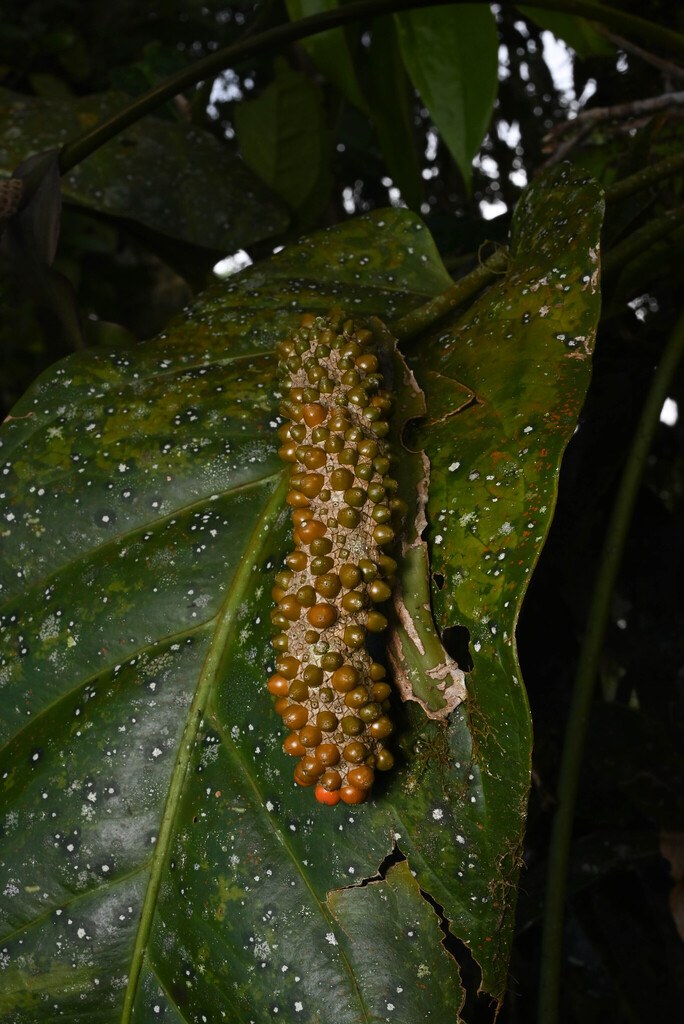
📷 Anders Hastings / iNaturalist (CC BY 4.0)
Field Guide · Anthurium
A Panamanian velvet that hides in plain sight — often mislabeled, frequently misunderstood, and one of the more forgiving members of the section Cardiolonchium.
Endemic to Panama's wet forests, ranchoanum produces narrow, sagittate blades with a soft matte sheen rather than the glassy shine of crystallinum. Venation is fine and pale green, not chalk-white, and the leaf surface holds a subtle olive cast in good light. It grows faster and tolerates household conditions better than most of its velvet cousins.
Editor's pickThe benchmark velvet anthurium, with rounder, more cordate leaves and the bright silver venation collectors recognize immediately. True crystallinum has a rounded (terete) petiole — if the petiole is winged or D-shaped, you likely have a hybrid or clarinervium. Slower than ranchoanum but more dramatic at maturity.
The benchmarkA Chiapas lithophyte with thick, leathery blades and bone-white venation on a near-black background. The petiole is sharply D-shaped, the leaves smaller and stiffer than crystallinum, and it prefers a chunkier, more mineral substrate. The most forgiving velvet for people without a grow tent.
Most forgivingLarger than crystallinum, with broader leaves and the diagnostic squared, winged petiole that ends arguments fast. Venation is a softer silver-green, and mature plants can push blades over two feet. Needs more room, more humidity, and more patience than ranchoanum, but rewards both.
For spaceThe peltate oddity — the petiole attaches to the underside of the blade rather than the notch, so there is no sinus at all. Leaves are nearly round, dark, and held flat like satellite dishes. Slower and fussier about wet feet than ranchoanum, but unmistakable on a shelf.
Collector's curioThe plant moves through the trade under several wrong names, usually crystallinum or some unspecified "velvet anthurium." The fastest tell is leaf shape: ranchoanum blades are distinctly longer than wide, with a narrow sagittate outline and a pronounced sinus. Crystallinum leaves are broader and more heart-shaped; magnificum leaves are larger still and rounder.
Look at the petiole next. Ranchoanum has a rounded to faintly sulcate petiole — never the squared, winged cross-section of magnificum, and never the sharp D-shape of clarinervium. Run a finger down it; if you feel four flat faces, you don't have ranchoanum.
Finally, check the venation under angled light. Crystallinum flashes bright silver-white on a dark ground. Ranchoanum has finer, paler venation that reads more sage-green than chrome, and the overall leaf surface is matte rather than crystalline. Juvenile plants can mislead — wait for the third or fourth adult leaf before committing to an ID.
Anthuriums in section Cardiolonchium are epiphytic or hemi-epiphytic at heart, and ranchoanum is no exception. The roots want air around them at all times. A working mix is roughly 40% medium orchid bark, 20% perlite or pumice, 20% coarse coco chips or chunky coco husk, and 20% sphagnum or fine bark for moisture retention. Add a handful of horticultural charcoal if you have it.
The mix should drain in seconds when you water and never feel sodden an hour later. Standard peat-based houseplant soil will kill this plant within a season — roots rot from the tip back, and by the time the lower leaves yellow, the crown is often already lost.
Repot every 18 to 24 months, or sooner if the chunky components have broken down to fines. Ranchoanum produces a thick, white aerial root system; if you see roots circling the pot or escaping the surface, give them room. A slightly snug pot is fine — anthuriums hate swimming in substrate.
Bright indirect light, full stop. East-facing windows are ideal; a few feet back from a south or west window with a sheer curtain works too. Direct midday sun bleaches the velvet finish and scorches the leaf surface within hours. Under LEDs, aim for around 150–250 µmol/m²/s at the canopy.
Water when the top inch of mix is approaching dry but the deeper substrate is still faintly cool to the touch. In a chunky mix this often means watering twice a week in summer and once every seven to ten days in winter. Water thoroughly — flush the pot — then let it drain completely. Never let the pot stand in a saucer of water.
Humidity should sit around 65–75%. Ranchoanum will survive at 55%, but new leaves come in smaller and the velvet character flattens. Pair humidity with airflow: a small clip fan on low, aimed past the plant rather than at it, prevents the fungal problems that follow stagnant humid air. If you can hear the fan, it's too strong.
The first is overpotting. A 6-inch nursery pot looks reasonable next to a mature leaf, but the root mass is often small enough for a 4-inch. Excess wet substrate around few roots is the single most common way collectors lose velvet anthuriums.
The second is fertilizer panic. Ranchoanum is not a heavy feeder. A quarter-strength balanced liquid feed (roughly 50–75 ppm N) every other watering during active growth is plenty. Crispy leaf margins almost always mean salt buildup or low humidity, not nutrient deficiency — flush the pot before you reach for more fertilizer.
The third is impatience with new leaves. Emerging blades are pale, floppy, and slightly translucent for one to two weeks before they harden off and develop full color. Resist the urge to move the plant, change the light, or mist the new leaf — disturbance during hardening is how you get permanent deformity.
The Field Guide from Leaf People.