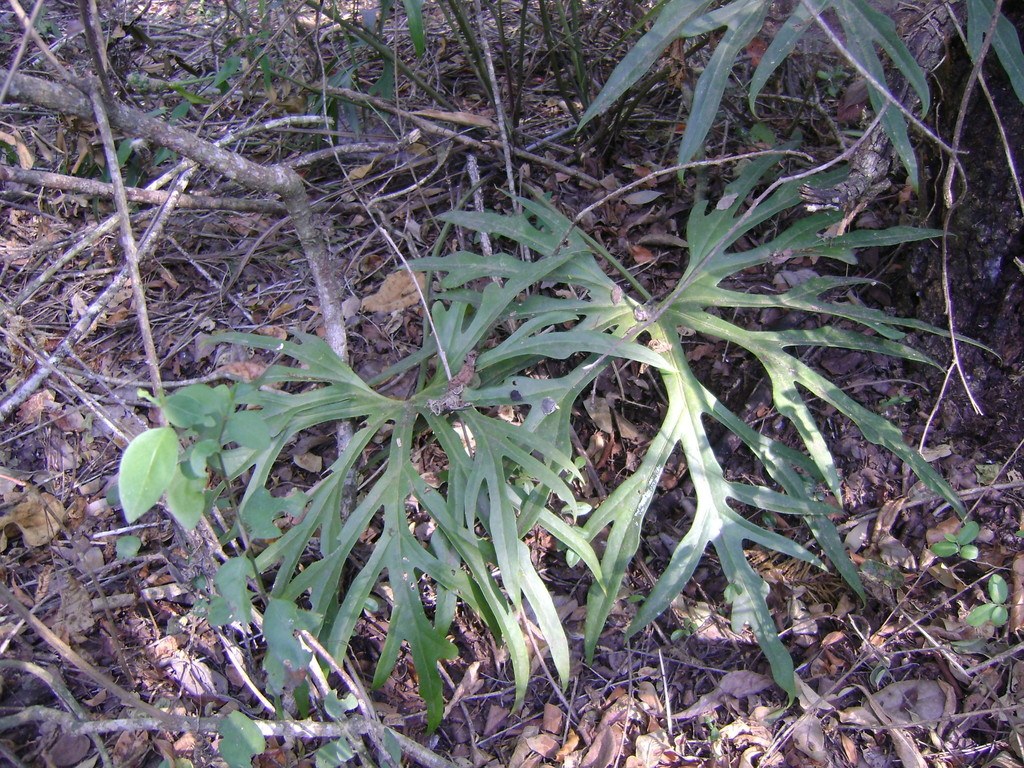
📷 Tereso Hernández Morales / iNaturalist (CC BY 4.0)
Field Guide · Anthurium
A Mexican cliff-dweller with leaves cut like a fern frond — and the most architectural anthurium you can actually keep alive indoors.
The headline plant: a Mexican species from limestone outcrops in Hidalgo and Veracruz, with mature leaves divided into 9 to 13 finger-like lobes on petioles that can clear three feet. Juvenile leaves are simple and unimpressive, which fools a lot of buyers. Give it a few years and a tall pot and it earns the space. Among lobed anthuriums, it's the most tolerant of average home humidity.
The headlinerA slender vining species from Colombia, Peru, and Brazil with leaves split nearly to the petiole into narrow, weeping leaflets. It reads more like a Schefflera than an anthurium until it blooms. Wants a slim moss pole and slightly warmer, wetter conditions than podophyllum. Stays compact enough for a shelf.
Best climberOften confused with podophyllum in the trade, but the lobes are narrower, more uniform, and the leaf sits on a shorter petiole. Also Mexican, also tough, and slightly more forgiving of dry air. The cultivar 'Fingers' is the form most collectors actually own. A good gateway lobed anthurium.
Most forgivingNot lobed, but it belongs in this conversation: another Mexican limestone species that thrives in the same conditions as podophyllum and pairs well in a shared setup. White venation on near-black velvet leaves. Slower than podophyllum but bulletproof once established in a chunky mix. Worth growing alongside the lobed species for contrast.
Companion pieceTechnically the leaf is compound rather than lobed — five to seven separate leaflets on a single petiole — but the visual effect is similar and the cultivation is close. Wide native range from Mexico to Brazil, and one of the few anthuriums that genuinely climbs tall. Wants more light than the Mexican species. Mature specimens are spectacular and still underpriced.
Sleeper pickAnthurium podophyllum is a hemi-epiphyte that grows on limestone cliffs and tree bases in the cloud forests of east-central Mexico. The roots want air, grit, and consistent moisture — not a wet sponge. A mix of roughly 40% orchid bark, 30% perlite or pumice, 20% coco chunks, and 10% worm castings, with a generous handful of horticultural charcoal, holds up for about two years before it breaks down.
Because mature plants can throw petioles three feet long, the root system needs to anchor a lot of leverage. Use a tall, narrow pot rather than a wide shallow one, and stake the petioles loosely if the plant starts to lean. Repot when you see roots circling the drainage holes, not on a calendar. This species sulks if disturbed too often.
One quiet advantage of podophyllum over the South American velvets: it tolerates tap water and standard tap pH better than crystallinum or magnificum. If your water is hard, the limestone heritage actually works in your favor.
Bright indirect light, full stop. An east window, or a few feet back from a south or west window with a sheer. Direct midday sun bleaches the leaves and crisps the lobe tips, which never recover — damaged lobes stay damaged for the life of that leaf, and leaves last years. Under grow lights, aim for around 150–250 µmol/m²/s at leaf height, 12 hours on.
Water when the top inch of mix is dry but the deeper substrate still feels cool. In a chunky mix that usually means every 5 to 8 days in summer, less in winter. Podophyllum is more drought-tolerant than most anthuriums — it would rather go a day dry than sit wet — but it will abort developing leaves if you let it desiccate hard.
Humidity above 60% produces the cleanest lobe development and the largest leaves. It will survive at 45–50% with smaller, sometimes incompletely cut leaves. Airflow matters as much as the humidity number; stagnant high humidity invites bacterial blight, which anthuriums catch easily and rarely shake.
Buying a juvenile and panicking. Seedling and young podophyllum leaves are simple, heart-shaped, and entirely unremarkable. The lobes appear gradually over successive leaves as the plant matures, usually starting around the fourth or fifth adult leaf. People assume they got the wrong plant and either return it or chop it. Be patient.
Treating it like a velvet anthurium. Podophyllum is not crystallinum. It wants more light, drier intervals between waterings, and a coarser mix. Care sheets that lump all anthuriums together will keep this one alive but never let it size up.
Crowding the petioles. Long petioles need room to extend and harden. A plant pressed against a wall or other foliage develops twisted, weak petioles that can't support the leaf blade. Give it a 360-degree clearance equal to the longest petiole, and rotate the pot a quarter turn weekly.
Fertilizer cowardice. Mature lobed leaves are expensive to build. Feed at quarter to half strength with a balanced synthetic (around 20-20-20 or a 3-1-2 ratio) every watering during active growth, and flush the pot with plain water monthly to keep salts from accumulating in the chunky mix.
The Field Guide from Leaf People.