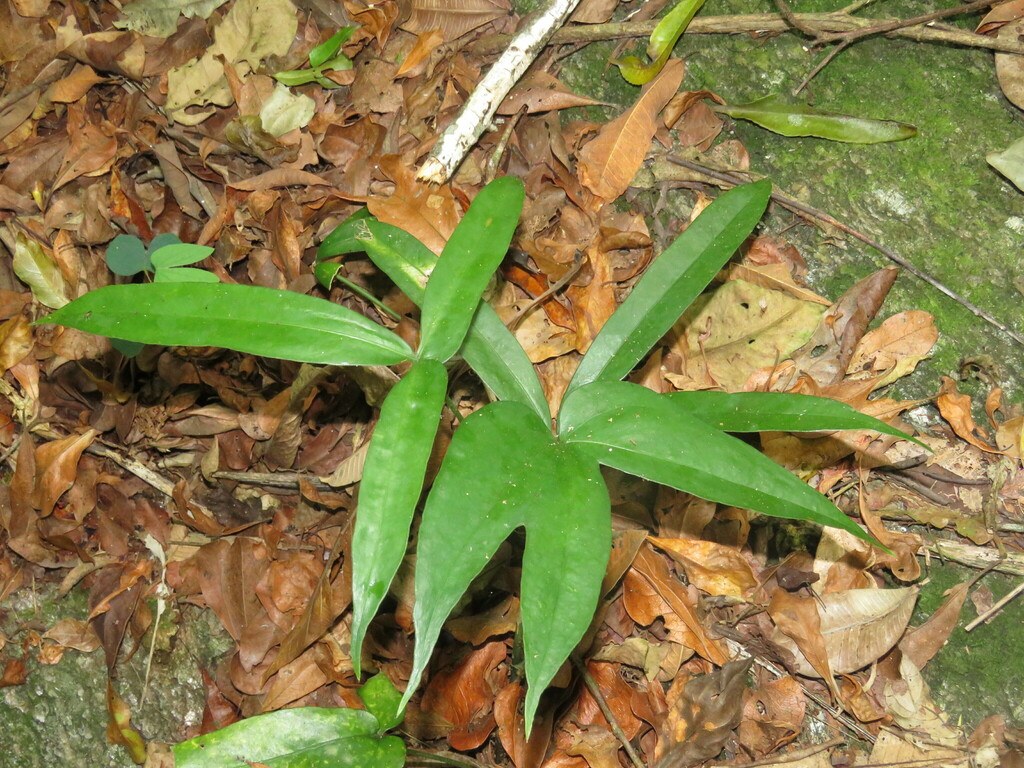
📷 Pablo Cauã da Silva Toledo / iNaturalist (CC BY 4.0)
Field Guide · Anthurium
The one anthurium that refuses to grow a simple leaf — and how to keep it climbing.
The headliner, and the only widely grown Anthurium in section Schizoplacium with reliably palmate-compound leaves. Mature plants throw five to eleven leaflets radiating from a single petiole, looking more like a Schefflera than an anthurium until the inflorescence appears. Native from southern Mexico through northern South America, usually climbing small trees in humid lowland forest. Juvenile leaves are simple or trifoliate, so patience is part of the deal.
The headlinerOften confused with pentaphyllum but smaller in every dimension, with seven to nine narrow, almost grasslike leaflets. It climbs eagerly on a thin totem and stays manageable under lights, which makes it the more apartment-friendly of the compound anthuriums. Found in the western Amazon basin, especially Colombia and Peru. Treat it slightly drier than pentaphyllum and it will run.
Best for shelvesNot strictly compound but pedately divided into long, finger-like segments — the effect is similar and the plant is spectacular at size. Mature leaves can clear three feet across in the wild, draped from canopy trunks in Central and South America. Indoors it stays smaller but still needs a real pole and headroom. Buy it knowing it wants to be a structural plant, not a tabletop one.
For the greenhouseA three-leaflet species from the Guianas and northern Brazil, sometimes traded under collection numbers rather than a clean ID. Smaller and slower than pentaphyllum, with thicker, semi-succulent leaflets that tolerate slightly lower humidity. A good gateway if you want the compound-leaf look without committing to a six-foot pole. Confirm the ID before you pay rare-plant prices — trifoliate juveniles of other species get mislabeled here constantly.
Gateway pickMexican endemic with enormous pedately divided leaves on long petioles, growing from a stout terrestrial rhizome rather than climbing. It tolerates cooler nights than most compound anthuriums and handles brighter light, which makes it a useful counterpoint on a mixed shelf. Dormancy is real — expect it to slow hard in winter and resist the urge to overwater. Mature specimens are show-stoppers and surprisingly available.
Cool tolerant
Most anthuriums collectors chase — crystallinum, magnificum, warocqueanum, clarinervium — sit in section Cardiolonchium and produce single, often velvet-textured cordate leaves. Anthurium pentaphyllum belongs to section Schizoplacium, a small group where the lamina is split to the petiole into discrete leaflets. The plant is not a curiosity grafted onto the genus; it is a climbing hemiepiphyte with the same growth strategy as a juvenile Monstera — root into bark, climb toward light, mature the leaves as it goes.
That climbing habit dictates almost everything about care. Juvenile plants in pots produce simple or trifoliate leaves and look unremarkable. Give them a damp, rough-barked pole or a slab, and the petioles lengthen, the internodes tighten, and the leaves start dividing. Without something to climb, pentaphyllum will sulk in a kind of permanent juvenility, throwing weak simple leaves for years.
Practically, this means a pole is not optional. A sphagnum-stuffed pole twelve to twenty-four inches taller than the plant, kept consistently moist, will pull aerial roots in within weeks. Once those roots attach, leaf size roughly doubles per cycle until the plant matures.
Substrate. Use a chunky aroid mix that drains in seconds: roughly equal parts orchid bark (medium grade), perlite or pumice, and a smaller fraction of coco chips or sphagnum for moisture retention. Avoid peat-heavy potting soil. The roots of pentaphyllum are thick and rope-like, adapted to running across wet bark, and they rot fast in anything that stays soggy in the center of the pot.
Light. Bright indirect — roughly 200 to 400 µmol/m²/s PPFD at the leaf, or a north-facing window with no obstruction, or an east window with sheer cover. Direct midday sun bleaches the leaflets to a flat yellow-green within a week. Under grow lights, keep the canopy twelve to eighteen inches off the diodes and run a twelve-hour photoperiod.
Water and humidity. Water when the top inch of mix is just barely damp, not bone dry. The pole should stay wetter than the pot; mist or top-water the moss every couple of days. Humidity is the negotiable variable: pentaphyllum tolerates 55% if airflow is good and the pole stays moist, but it leafs out faster and larger above 70%. A small clip fan moving air across the foliage matters more than a humidifier cranked to 90%.
Treating it like a velvet anthurium. Pentaphyllum is not crystallinum. It wants more light, more airflow, and a pole. Tucked into a low-light cabinet with the velvets, it stalls.
Expecting compound leaves on a juvenile. New imports and seed-grown plants almost always arrive with simple or three-part leaves. The split-leaf form is a maturity trait. If you buy a small plant, plan on twelve to twenty-four months on a pole before the leaves start dividing properly.
Letting the pole dry out. This is the single most common failure. A dry sphagnum pole is just decoration — the aerial roots won't attach, and the plant reverts to pot-bound growth. Soak the pole at every watering and refresh the sphagnum yearly.
Overpotting. A pot two inches wider than the root mass is plenty. Pentaphyllum climbs out of its pot, not into a bigger one; the energy goes up the pole, not into root volume. Oversized pots stay wet at the center and invite Pythium.
The Field Guide from Leaf People.