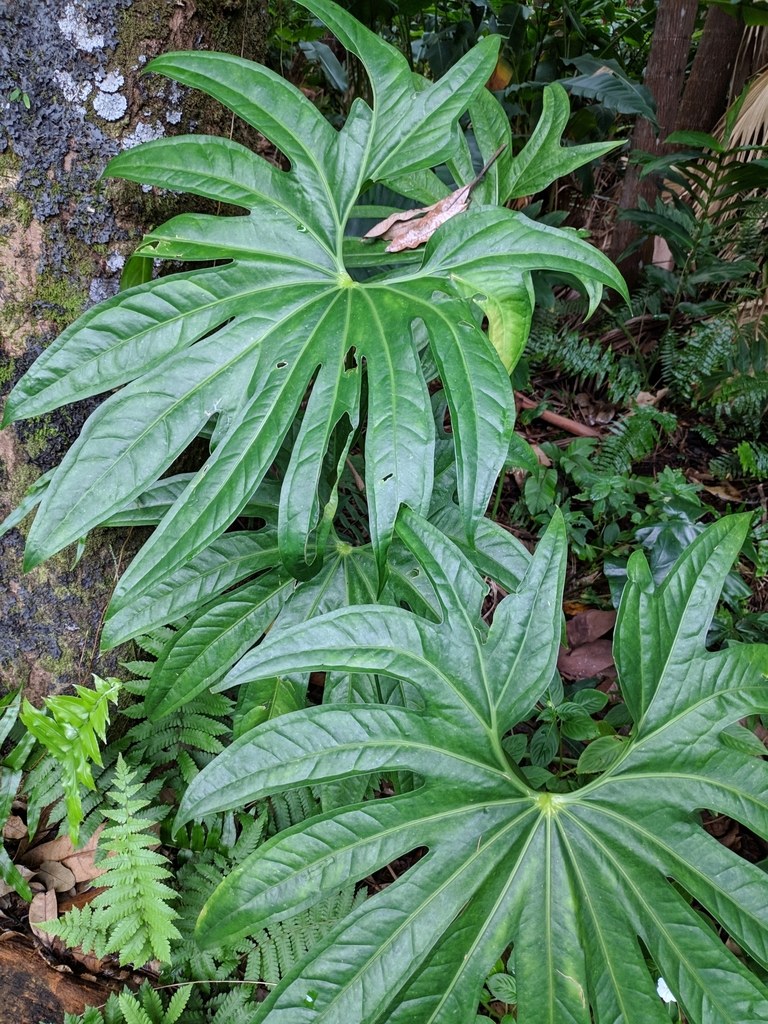
📷 no rights reserved / iNaturalist (CC0)
Field Guide · Anthurium
A Mexican lobed-leaf oddity that grows like a weed once you stop treating it like a velvet queen.
Native to the cloud forests of Veracruz and Oaxaca, this is the easiest of the lobed-leaf anthuriums and the gateway species for the group. Mature leaves split into seven to eleven finger-like segments on a stiff petiole, held almost horizontally. Tolerates ordinary apartment humidity better than nearly any other sectional anthurium, which is why it keeps showing up on collector windowsills. Not a true velvet, despite the nickname — the surface is matte, not crystalline.
Best starterA South American climber from Peru, Colombia, and Brazil with deeply palmate leaves cut into narrow, almost grass-like fingers. Smaller in every dimension than pedatoradiatum and faster to mature on a slim moss pole. Wants more humidity — 70% is comfortable — and resents stagnant air. Often sold as the "five-fingered anthurium," though leaf segment counts vary.
Most gracefulThe largest of the commonly grown lobed anthuriums, with mature leaves that can exceed two feet across and dissect into deeply pinnatifid segments. Endemic to Mexico, it behaves more like a terrestrial than its cousins and appreciates a heavier, soil-inclusive mix. Slow to size up but spectacular once it does. Needs floor space, not shelf space.
Statement plantUnusual among anthuriums in producing truly compound leaves — five separate leaflets radiating from a central point, like a schefflera designed by someone with better taste. Climbs aggressively given a damp pole and humidity above 65%. Found from Mexico through northern South America in a confusing tangle of varieties. Worth tracking down if you already grow the simpler lobed species well.
Collector's pickA less common Colombian species with elongated, deeply divided leaves that hang rather than spread. Grows best mounted or in a net pot where the petioles can arch. Care overlaps with pedatoradiatum, but it asks for steadier humidity and dislikes drying out fully. A good next step once the entry-level lobed species is thriving.
Underrated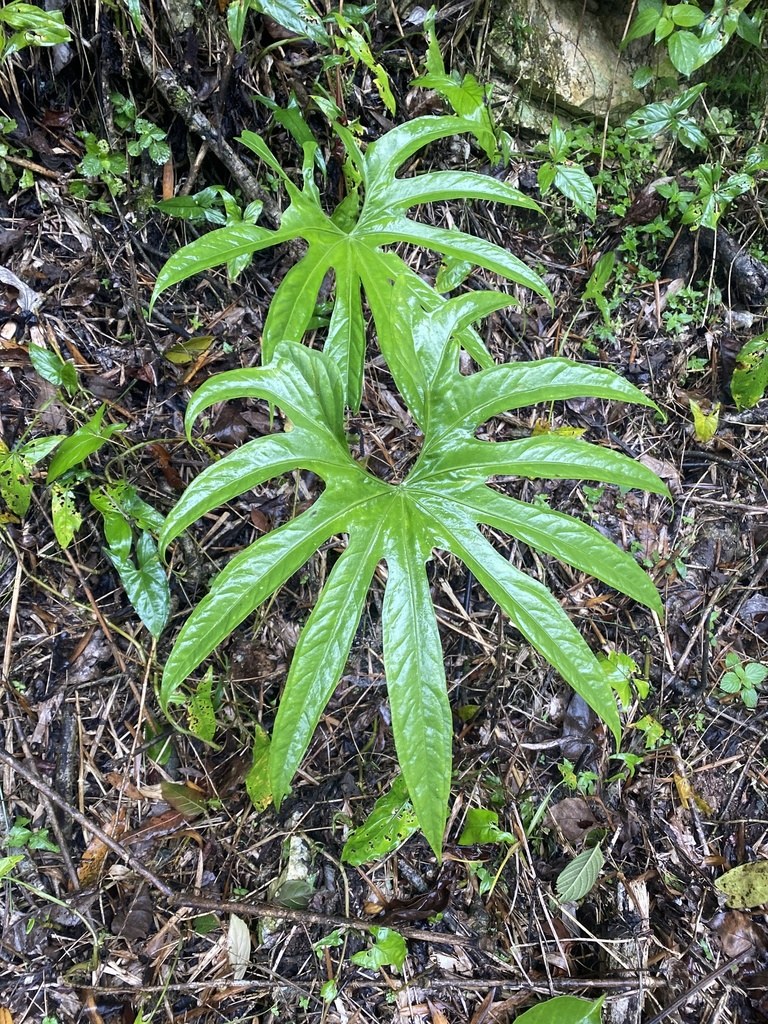
Anthurium pedatoradiatum is a hemi-epiphyte, which means its roots want air at least as much as moisture. A working mix is roughly 40% chunky orchid bark, 20% perlite or pumice, 20% coco chunks or charcoal, and 20% sphagnum to hold tension. The goal is a substrate that drains in seconds but stays cool and slightly damp at depth for a day or two after watering.
Skip dense peat-based houseplant soils. They compact, stay wet at the core, and rot the thick fleshy roots this species produces. If you only have bagged aroid mix, cut it 50/50 with extra bark and perlite before potting.
Repot every 18–24 months, or when roots circle the pot and water starts running straight through. Use a pot only one size up — this is not a plant that rewards overpotting, and a too-large volume of wet media is the fastest way to lose one.
Bright indirect light, full stop. An east window, or a few feet back from a south or west window with sheer diffusion, is ideal. Under grow lights, aim for around 150–250 µmol/m²/s at leaf height for 12 hours. Direct midday sun bleaches the matte surface and crisps the lobe tips within a week.
Water when the top inch of substrate is dry but the core still feels cool to the touch. In a chunky mix that usually means every 5–8 days in summer and every 10–14 in winter. Use room-temperature water; cold tap water on warm leaves will spot them. Rainwater or filtered water is kinder over the long term, but tap is workable if your area is not heavily chlorinated.
Humidity is where this species earns its reputation as the easy one. It will hold form at 50%, look its best at 60–70%, and does not require a closed cabinet to thrive. What it does need is airflow — a small clip fan moving air across the leaves prevents the fungal spotting that plagues stagnant setups.
Treating it like a velvet anthurium. Pedatoradiatum is not crystallinum, not magnificum, not papillilaminum. It does not need a 80% humidity tent and it actively dislikes constant sphagnum wetness around the crown. Grow it more like a Philodendron than like a velvet.
Underestimating mature size. Juvenile leaves are entire or shallowly lobed and look nothing like the adult form. Growers see no fingers after a year and assume they bought a mislabeled plant. The lobing develops as the rhizome gains girth — usually leaf six or seven onward. Patience, not intervention, is the answer.
Too-small pot, then too-large pot. People starve the plant in a 4-inch nursery pot for two years, then panic-pot it into a 10-inch ceramic. The shock of going from root-bound to swimming in wet mix triggers root rot every time. Step up one size, let it settle for a season, then step up again.
The Field Guide from Leaf People.