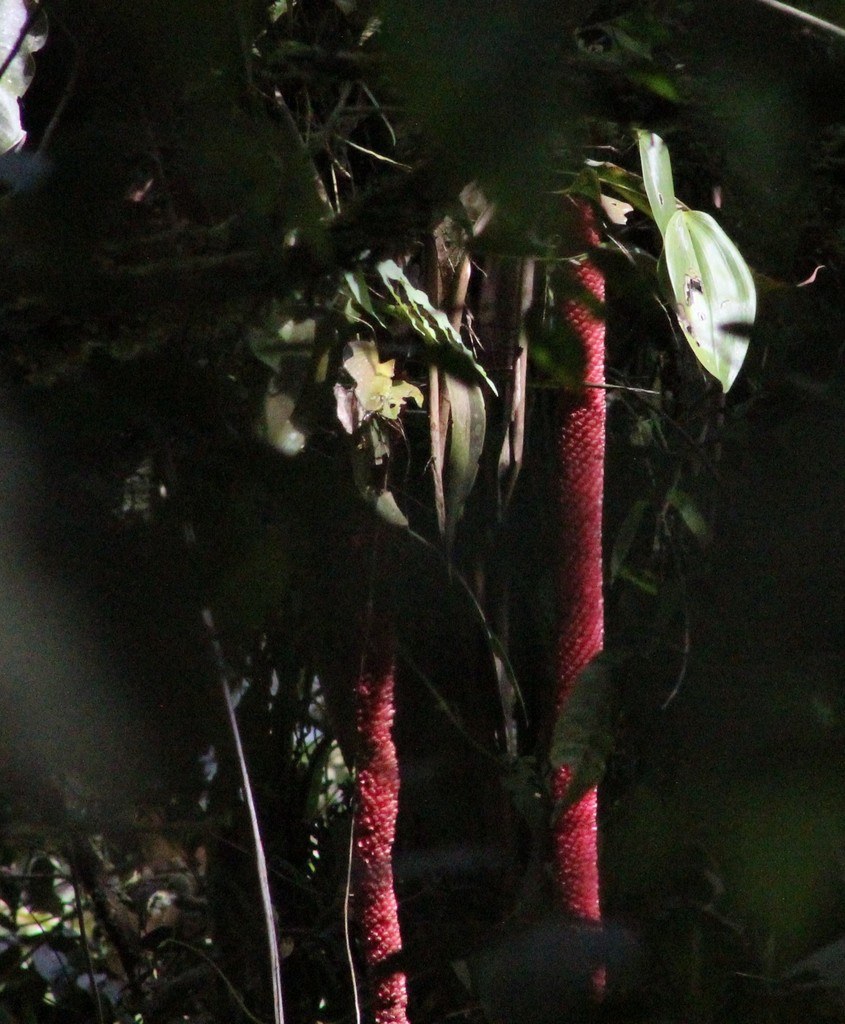
📷 Michael Bakker Paiva / iNaturalist (CC BY 4.0)
Field Guide · Anthurium
A guide to the soft-leaved, almost circular anthurium that confuses everyone who meets it — and four relatives that belong on the same shelf.
The reason you're here. Mature leaves are nearly orbicular, matte, and softly velvet, held on short petioles in a low rosette rather than the long-pendant habit of warocqueanum. Native to wet forest in Colombia and Ecuador, it stays compact — most plants top out around 30 cm leaf length — which makes it one of the more apartment-friendly velvets. Often confused in trade with A. niqueanum and juvenile A. magnificum.
The headlinerThe gateway velvet. Thick, dark green hearts with bone-white venation, native to limestone outcrops in Chiapas, Mexico. It tolerates lower humidity than the South American velvets — 55% is workable — and forgives the occasional missed watering thanks to a stout rhizome. Worth growing even after you've moved on to rarer species.
Most forgivingBigger, glossier, and squarer in the petiole than ovatifolium — the winged, four-sided petiole is the diagnostic. Leaves can pass 60 cm in cultivation with silver-white primary veins on olive-green velvet. Wants real humidity (70%+) and an open mix; sulks in peaty soil. The crosses with crystallinum are common in trade and usually mislabeled.
Statement pieceSmaller and faster than magnificum, with narrower, more elongate hearts and brilliant silver venation. New leaves emerge wine-red and harden to deep green over a few weeks. Native across Panama, Colombia, and Peru in wet midstory forest. The most available true velvet and a reliable benchmark — if you can grow crystallinum well, you can grow the others.
Best valueThe connoisseur's pick. Endemic to a small slice of Panamanian rainforest, with long, narrow, blackish-green velvet leaves and a deeply quilted texture. Demands consistent 75%+ humidity, moving air, and warmth — it punishes neglect more than any other species on this list. True dressleri is rare in cultivation; most plants sold under the name are hybrids.
Collector grail
Anthurium ovatifolium is a wet-forest terrestrial, not an epiphyte clinging to a mossy branch. That distinction matters because it sets the substrate strategy: the roots want air and consistent moisture at the same time, with no anaerobic pockets. A mix I've had long-term success with is roughly 40% medium orchid bark, 30% perlite or pumice, 20% chunky coco husk, and 10% fine charcoal, with a thin top dressing of sphagnum to keep the surface from drying too fast. Skip peat-heavy aroid mixes — they compact within a season and rot the thick, fleshy roots this species depends on.
Light is the part most growers get wrong in the other direction. Velvets are understory plants, but understory in an Ecuadorian cloud forest is brighter than the corner of your living room. Aim for 150–250 µmol/m²/s at the leaf, or in practical terms, a spot 30–60 cm under a decent LED bar, or two feet back from an unobstructed east window. Direct midday sun will scorch the velvet within an afternoon; deep shade produces stretched petioles and leaves that never develop the rounded adult form.
Water when the top centimeter of the mix is just starting to dry — usually every 4–6 days in a chunky substrate at room temperature. Use rainwater, RO, or tap that's been sitting out, because ovatifolium is sensitive to salt buildup and will show it as crispy leaf margins within a few months of hard-water irrigation. Humidity is non-negotiable: 70–80% is where this plant moves from surviving to producing the textbook round leaves. Below 55% you'll get smaller, narrower foliage and stalled growth, even if everything else is dialed in.
High humidity without airflow is how velvet anthuriums die. Stagnant moist air invites bacterial blight (Xanthomonas), which presents as translucent yellow lesions that turn brown and spread along veins — usually fatal once established. A small clip fan on low, running 24/7 across the canopy, does more for plant health than any fungicide. In a sealed cabinet or IKEA greenhouse, this is the single upgrade I'd recommend before any light or substrate change.
Temperature should sit between 20–28°C. Ovatifolium tolerates brief dips to 16°C but stops rooting below 18°C, which is why winter is when most collectors lose plants — not from cold itself, but from cold wet substrate that the roots can't process. If your grow space drops at night, water in the morning and let the mix breathe through the cool hours.
Feed lightly and constantly rather than heavily and occasionally. A balanced fertilizer at quarter strength (around 100–150 ppm N) with every other watering keeps leaves dark and petioles stout. Flush the pot with plain water once a month to clear accumulated salts. Repot only when you see roots circling the bottom or the mix has broken down into mush — usually every 18–24 months. This species resents root disturbance and often pauses for two months after a repot, so time it for spring when light is increasing.
Buying mislabeled stock. A. ovatifolium is genuinely uncommon, and a lot of what circulates under the name is A. niqueanum, juvenile magnificum, or hybrids. Check the petiole (terete, not winged), the leaf shape on a mature plant (orbicular to broadly ovate, not elongate-cordate), and ideally buy from a seller who can show the parent plant in leaf.
Treating it like a philodendron. Velvet anthuriums don't bounce back from drought or overwatering the way a Philodendron gloriosum will. The roots are thicker, slower, and less forgiving. Consistency beats correction — a plant kept at a steady 70% humidity and watered on a rhythm will outperform one cycled between extremes, even if the averages are identical.
Pushing for size. The temptation with any velvet is to chase the next leaf bigger than the last. Heavy feeding, intense light, and constant repotting will get you fast growth and weak, thin leaves prone to blight. The plants that look best at five years old are the ones that grew slowly under stable conditions, putting out three or four properly hardened leaves a year.
The Field Guide from Leaf People.