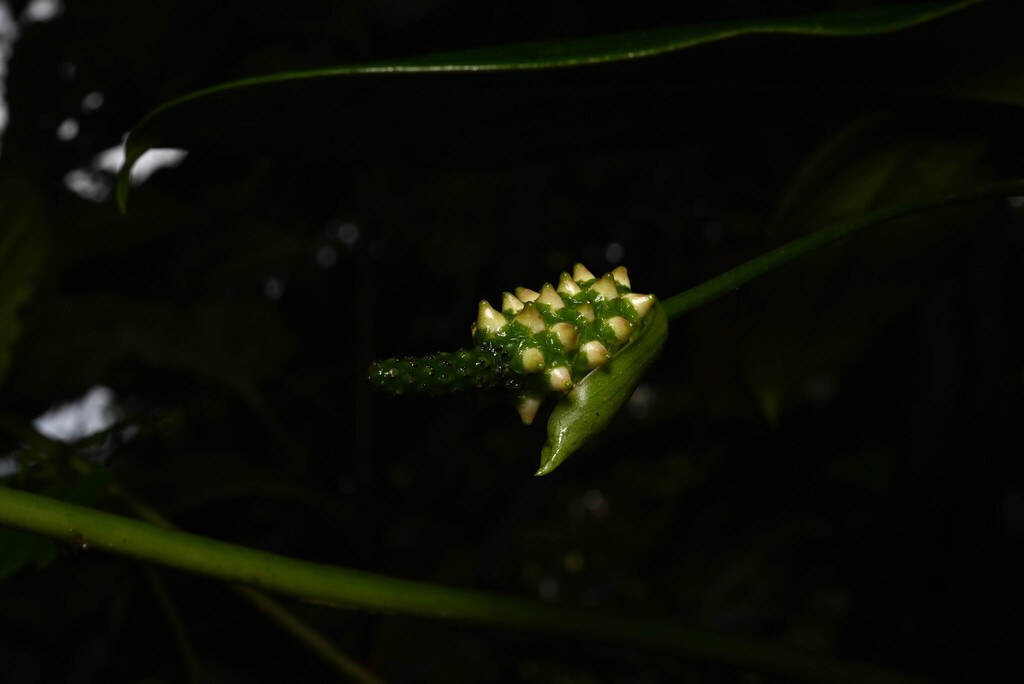
📷 Anders Hastings / iNaturalist (CC BY 4.0)
Field Guide · Anthurium
A pendulous Panamanian rosette that wants air at the roots, humidity at the leaves, and patience from the grower.
The reason you're here. A. michelii throws long, ribbon-like leaves from a tight central rosette, eventually cascading four to six feet over the pot rim. Native to wet Panamanian forests, it's an epiphyte at heart and rots fast in dense soil. Give it a wide, shallow basket and let the leaves drape.
The subjectEcuadorian, stiff, and architectural — A. superbum holds bronze-flushed paddle leaves nearly vertical, with deeply impressed venation that catches light like hammered metal. It tolerates lower humidity than most birds'-nest types and forgives a missed watering. A good gateway into the section Pachyneurium.
Most forgivingThe undulate margins on a mature plowmanii are unmistakable: long, ruffled straps that ripple like a fan dancer's hem. Brazilian in origin, it grows large — three feet across is routine — and handles bright light better than its cousins. Cheap, vigorous, and underrated.
Best valueHeavier and more leathery than michelii, A. jenmanii forms a classic bird's-nest with broad, slightly cupped leaves that catch falling debris in habitat. It's the parent of countless Indonesian hybrids and crosses readily with A. hoffmannii and A. superbum. Slow but stately.
Hybridizer's pickThe real hookeri — not the impostor sold under that name for decades — has tiny black dots on the petioles and rounded purple berries. Caribbean and northern South American, it tolerates more airflow than most and resents waterlogged media. Verify the seller; mislabeling is the rule, not the exception.
Provenance matters
Bird's-nest anthuriums fail in dirt. A. michelii in particular grows as an epiphyte or lithophyte in the wild, anchoring to mossy branches and limestone where rain rinses through in seconds. Replicate that. A working mix is roughly 40% chunky orchid bark (medium grade), 20% perlite or pumice, 20% coco husk chips, and 20% sphagnum or tree-fern fiber for moisture retention. The mix should hold a leaf's weight when you squeeze a handful, then fall apart when you let go.
Pot choice matters as much as media. A wide, shallow basket — teak, cedar, or a net pot lined with sphagnum — beats a deep nursery pot every time. The rosette wants its crown well above the media surface; bury it and you'll watch the center collapse in a month. If you must use plastic, drill extra side holes and prop the plant so the growth point sits proud.
Repot every 18 to 24 months, or sooner if the bark has broken down to mush. Fresh roots are white with green tips; brown, hollow roots mean you waited too long or watered a dense mix. Trim the dead, dust cuts with cinnamon if you're nervous, and reseat in fresh chunky media.
A. michelii wants bright indirect light — roughly 150 to 250 µmol/m²/s if you measure, or a spot two to four feet from an east or shaded south window. Direct midday sun bleaches the strap leaves to a dull yellow-green and scorches the tips within a week. Too little light, and the new leaves emerge short and floppy, never reaching the cascading length that makes the species worth growing.
Water when the top inch of media approaches dry but the core is still faintly moist. In a chunky mix and a basket, that's often every three to five days in summer, weekly in winter. Use rainwater, RO, or filtered tap — anthuriums in section Pachyneurium are sensitive to mineral buildup, and leaf-tip burn from hard water is the most common complaint I hear. Flush the pot thoroughly once a month.
Humidity is non-negotiable. Aim for 60% or higher; below 50% the new leaves emerge crinkled and the older leaves develop crispy margins. A grow tent, an Ikea cabinet retrofit, or a humid greenhouse window all work. Pair humidity with airflow — a small clip fan on low, twelve hours a day — or you'll trade tip burn for bacterial blight, which is worse.
The fastest way to kill A. michelii is to treat it like a philodendron. Standard aroid mix is too dense; standard pots are too deep; standard watering schedules drown the crown. If the central growth point ever looks translucent or smells sour, stop watering immediately, unpot, and inspect. Crown rot moves fast and is rarely reversible past the early stage.
Yellowing of the oldest leaf is normal — these are rosette plants and shed from the bottom as they push from the center. Yellowing of multiple leaves at once, or yellowing that starts at the petiole, points to root loss. Pull the plant; if the roots smell like a pond, you're overwatering or the media has collapsed.
Fertilize lightly and often. A balanced liquid feed at quarter strength every second watering, plus a pinch of slow-release on top of the media each spring, keeps the plant pushing without burning the sensitive root tips. Skip the bloom boosters; flowering in michelii is unremarkable and not the point. You're growing this plant for the leaves, and the leaves reward steady, boring consistency more than any single dramatic intervention.
The Field Guide from Leaf People.