📷 EstebanMH / iNaturalist (CC BY 4.0)
Field Guide · Anthurium
A Panamanian climber whose leaves turn the color of cold metal when you grow it right.
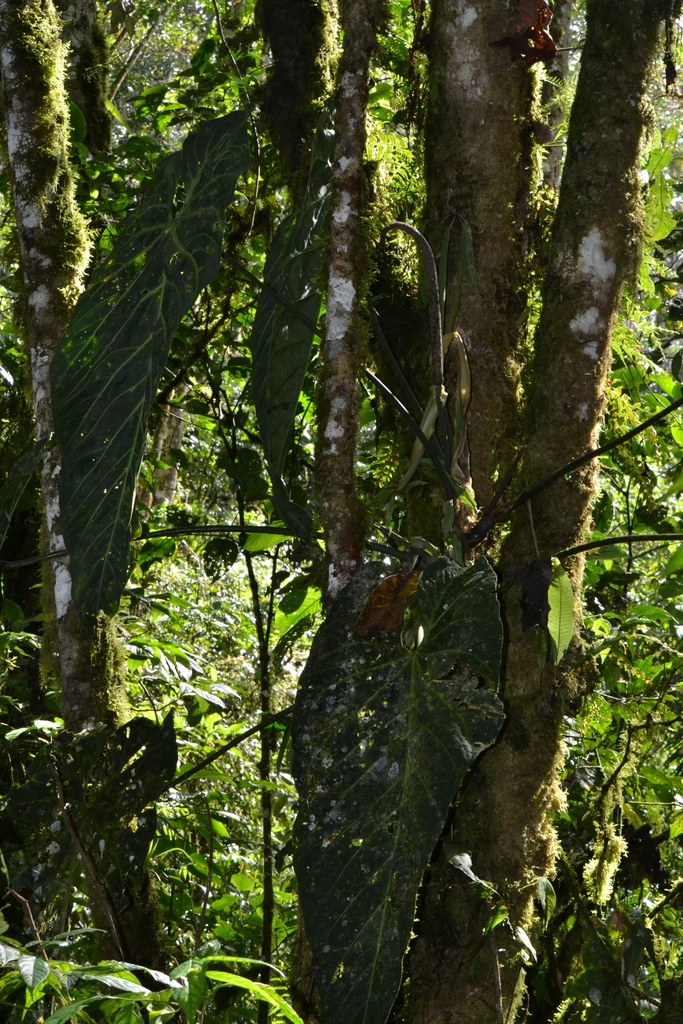
The reason you came. Pendant lanceolate blades 40–70 cm long, matte at first then settling into a cool pewter wash as they harden. Native to cloud forest in Panama, where it climbs phorophytes in deep shade and constant mist. Sheen is environmental as much as genetic — dim it and the silver leaves with you.
The headlinerOften confused with metallicum by sellers who should know better. Heart-shaped, held more horizontally, with brighter white venation and a shorter petiole that's round in cross-section (not the D-shape of metallicum). Easier to grow, faster to push leaves, and forgiving of slightly lower humidity. A good first velvet anthurium.
Easiest velvetColombian, larger in every dimension, and unmistakable for its squared, winged petioles. The venation is broader and chalkier than crystallinum, and mature leaves can pass 60 cm. Wants the same wet-airy mix as metallicum but tolerates a bit more warmth and slightly drier air once established.
The big oneThe Chiapas outlier — not velvety but heavily quilted, with bone-white venation on a dark olive ground. Grows on limestone in the wild, which tells you everything: it wants more air at the roots and tolerates drier conditions than its South American cousins. The gateway anthurium for collectors who can't hit 70% humidity.
Most forgivingThe peltate one — no sinus, the petiole attaches inside the leaf margin, giving a perfect shield. Smaller than metallicum, with a soft silver overlay on some clones (the so-called 'silver' forgetii). Wants the same conditions as metallicum and rewards you with berries that ripen lavender-white.
Collector's pick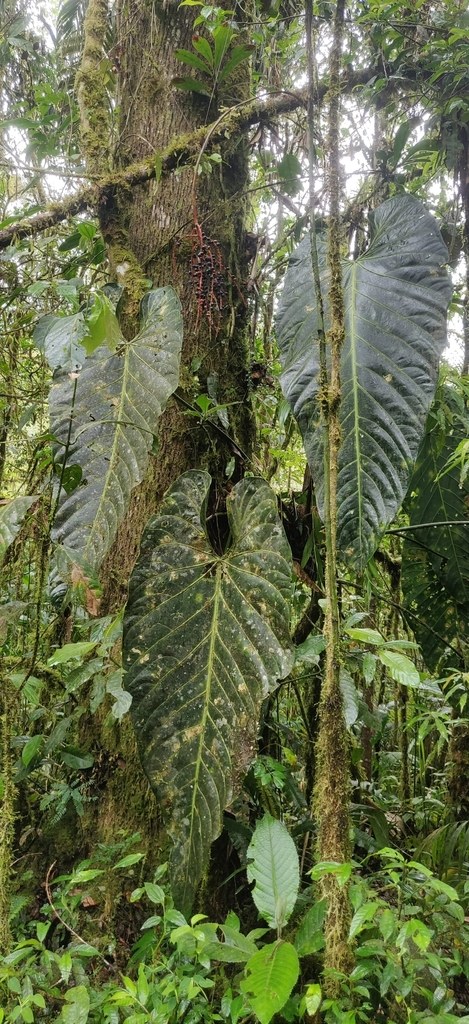
The metallic effect on Anthurium metallicum is structural, not pigmented. The upper epidermis is built from convex cells with a thin air layer beneath that scatters light at a narrow angle — the same trick that makes Begonia pavonina blue. When the leaf hardens correctly, that microstructure reads as cold silver. When it doesn't, you get a flat matte green that's still attractive but not what you paid for.
Two things wreck the sheen. The first is low humidity during leaf expansion: the cells collapse slightly as they cure, flattening the optical layer. The second is too much light, which thickens the cuticle and dulls the reflection. A leaf that emerged in a 75% tent and hardened under bright indirect light will read pewter for its entire life. A leaf that expanded on a dry shelf will not recover, no matter what you do later.
This is why growers obsess over the unfurl. The leaf you see is the leaf you keep for a year or more. Get the conditions right for the four to six weeks of expansion and hardening, and the plant will carry that work until the next leaf replaces it.
Metallicum is a climber with thick, white, fleshy roots that want oxygen as much as moisture. A peat-heavy mix will rot it within a season. The standard collector's blend is chunky orchid bark, perlite, and either sphagnum or coco husk chunks in roughly equal parts, with a handful of horticultural charcoal. The mix should drain freely when you pour water through it and still feel damp three days later.
Water when the top inch is approaching dry but the lower mix is still cool to the touch. In a chunky aroid mix that's often every four to seven days indoors, longer in winter. Use rainwater or RO if your tap runs hard — anthuriums burn leaf tips on accumulated salts faster than philodendrons do. Fertilize lightly and constantly rather than heavily and rarely: a quarter-strength balanced feed every watering works better than monthly full doses.
Mount or stake. Metallicum in the wild climbs, and a totem of damp sphagnum wrapped in coir gives the aerial roots something to grip and drink from. Plants run flat in a pot will produce smaller leaves with shorter petioles and, eventually, sulk.
Bright indirect light, full stop. Think a north window with no obstruction, or a few feet back from an east window. Direct sun — even an hour of afternoon — bleaches the velvet to a tired bronze and can scorch through to necrosis. Under grow lights, 100–150 µmol/m²/s at the leaf surface is plenty. More light does not equal more growth in this species; it equals stress.
Humidity wants to sit above 70% during active growth, with airflow. Stagnant high humidity is how you get bacterial blight — wet, translucent spots that spread along the veins and end careers. A small clip fan moving air across the canopy, even gently, prevents most of it. If you cannot hold 60% reliably, grow clarinervium instead and come back to metallicum when you build a cabinet.
The mistakes that kill metallicum are predictable. Overpotting into a too-large container that stays wet. Tap water with high TDS, which burns roots invisibly before the leaves show it. Letting the sphagnum on a mount go bone dry between waterings, which kills the aerial roots and stalls growth for months. And — most common — buying a mislabeled crystallinum from a vendor and assuming the easier care of that species will work here. It won't quite. Metallicum is fussier, slower, and worth the trouble.
The Field Guide from Leaf People.