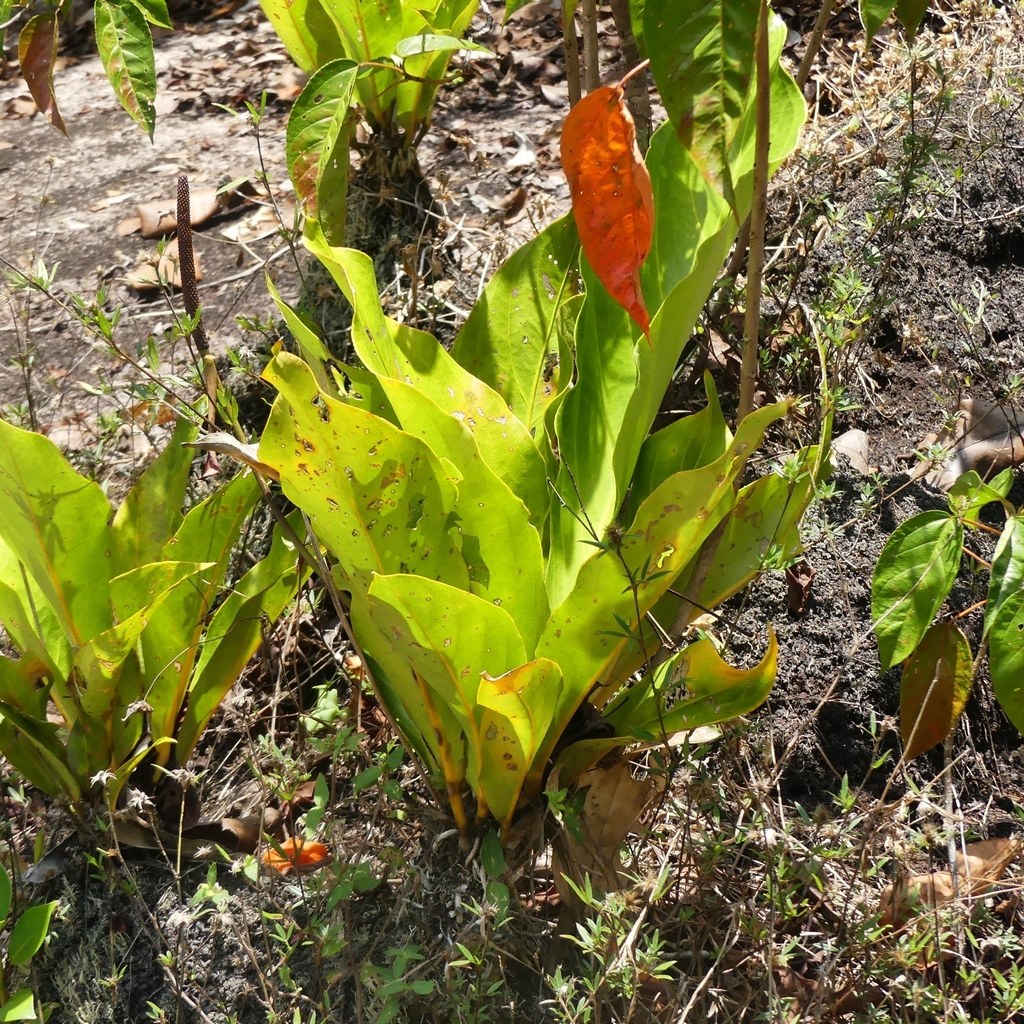
📷 Guillaume Delaitre / iNaturalist (CC BY 4.0)
Field Guide · Anthurium
The leathery, ribbed rosettes that turned Indonesian export nurseries into a global obsession — and how to actually keep one happy.
The species that built the bird's-nest market. Wild jenmanii from the Guianas and northern Brazil produces stiff, paddle-shaped leaves with a slight wave at the margin and a pronounced midrib. Indonesian growers have run it through decades of selection, so most plants in circulation are seed-grown selections rather than wild collected. Forgiving of warm nights and tolerant of brighter light than most velvets.
The benchmarkEcuadorian bird's-nest with bronze new leaves that harden to deep olive, held nearly vertical to form a debris-catching cup. The underside is a clear maroon, and mature leaves carry sharp ribbing along the midvein. More compact than jenmanii and arguably the easiest true bird's-nest for a shelf or cabinet. Wants stiffer airflow than people expect.
Most forgivingBrazilian species with thick, undulating leaves that ripple along the edge — sometimes sold as 'Fruffles' for the most extreme clones. Grows large; a settled plant easily throws three-foot leaves and resents being shuffled around. Tougher than jenmanii in low humidity and handles a few hours of morning sun without bleaching.
Best for sizeOften confused with jenmanii in trade, but true hookeri has tiny black glandular dots along the leaf margin and a narrower, more tapered blade. Caribbean and northern South American range. Slower than jenmanii but produces a tidier rosette with age. Buy from a grower who can show the dotted margin in a clear photo.
Often mislabeledAn Indonesian selection with leaves that curl inward at the tip, giving the rosette a hooded silhouette. Stable from seed when both parents are selected, which is why mature 'Cobra' plants still command real money even as standard jenmanii has commoditized. Care is identical to the species; treat as a slightly slower grower.
Collector cultivar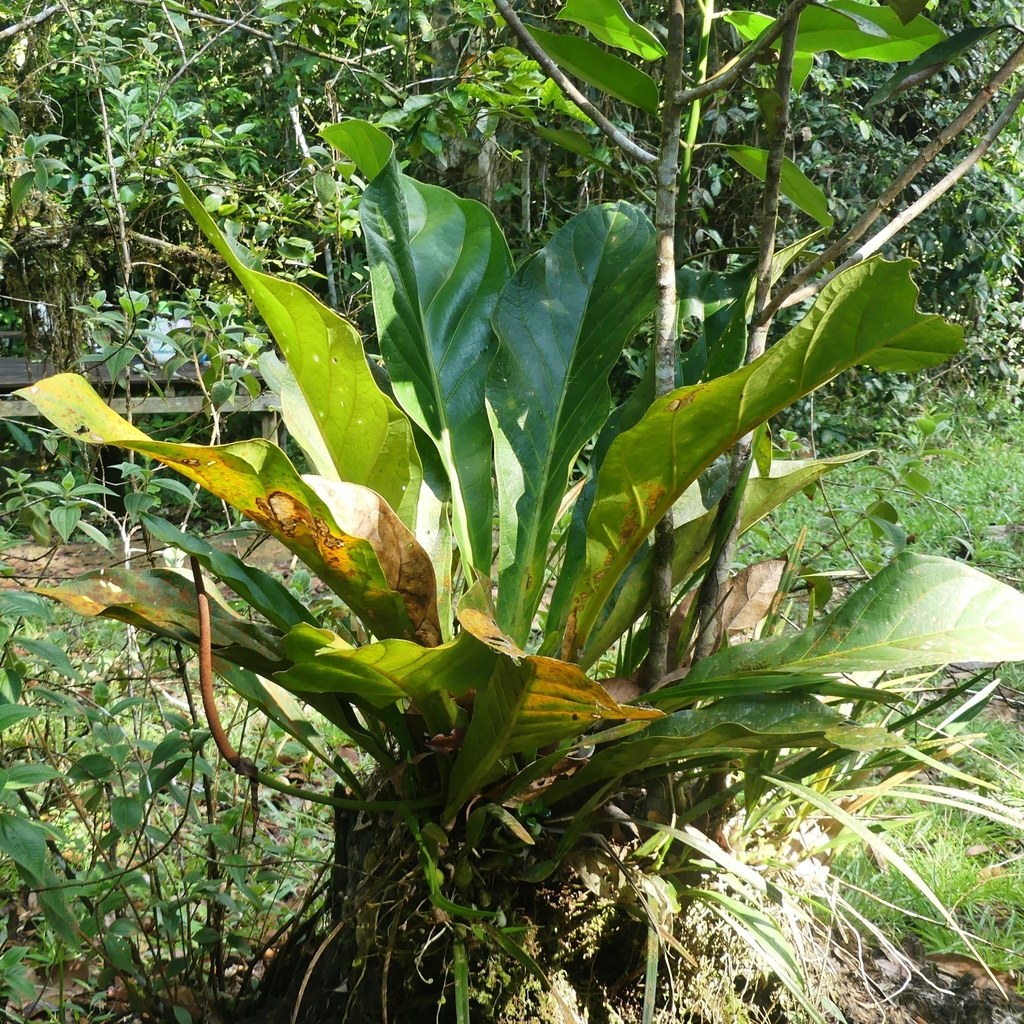
.Anthurium jenmanii became a status plant in Southeast Asia in the mid-2000s, when Indonesian and Thai nurseries began selecting for thicker leaves, tighter rosettes, and unusual leaf shapes. At the peak, single mother plants of named selections changed hands for thousands of dollars in Jakarta and Bangkok. That bubble deflated, but the breeding work didn't — it produced a generation of stable seed-grown lines (jenmanii 'Cobra', 'Big Wave', various local selections) that are now the backbone of the bird's-nest section of every serious aroid vendor.
For a Western collector, the practical effect is that a healthy young jenmanii is cheap and a named, mature selection still isn't. The premium sits on form: leaf thickness, rib depth, wave pattern, and how tightly the rosette holds. If you're buying for the long haul, pay for a plant with four or five adult-form leaves rather than a seedling — juvenile jenmanii leaves look almost nothing like the adult.
One warning specific to this group: ID is a mess. Jenmanii, hookeri, superbum, and a handful of regional forms get swapped around in trade constantly, and Indonesian export tags don't always survive translation. Learn the marginal-dot test for hookeri and the leaf-underside color for superbum before you spend real money.
Bird's-nest Anthuriums are epiphytes or near-epiphytes — they grow in leaf litter caught in tree crotches, not in soil. The substrate has to drain fast and stay airy. A working mix is roughly 40% medium orchid bark, 20% perlite or pumice, 20% coco chunks or chopped tree fern, and 20% a moisture holder like sphagnum or coco coir. Skip peat-heavy aroid mixes; jenmanii rots from the crown when the base stays wet.
Light is where most growers undershoot. Jenmanii and plowmanii both take more light than velvet Anthuriums — think 200–400 µmol/m²/s at the leaf, or a bright east window with sheer diffusion. Underlit plants produce thin, floppy leaves that never develop the ribbing the species is grown for. Superbum wants slightly less; bronze new growth bleaches yellow under hard light.
Water deeply, then let the top third of the mix dry. These plants store water in thick petiole bases and a stubby caudex, and they tolerate a dry stretch far better than a soggy one. Rainwater or RO is ideal — the leaves are leathery enough to show mineral spotting from hard tap water within a few months. Fertilize lightly and constantly: a balanced liquid feed at quarter strength every watering beats monthly heavy doses.
Humidity matters less than people assume. A settled jenmanii holds adult leaves down to 50% relative humidity without edge burn, which is part of why it travels well. What it won't tolerate is stagnant air at high humidity — that combination produces bacterial blight, which shows up as translucent yellow patches that turn black and spread along the midrib within days. Run a small fan in any enclosed grow space.
The most common killer is planting too deep. The growing point sits at the top of a short vertical caudex; bury it under wet sphagnum and the whole rosette collapses from crown rot. Pot so the base of the lowest leaf sits just above the substrate line, and stake the plant if it wants to lean. Cork rounds, tree-fern slabs, and net pots all work better than standard nursery plastic for mature specimens.
Two other failure modes worth naming. First, cold wet roots: below about 60°F (15°C) with damp media, roots stop functioning and rot follows. Second, sudden light increases — moving a cabinet-grown plant to a south window in April will scorch every adult leaf within a week. Step light up over three or four weeks, and you'll get the thick, ribbed adult foliage these species were selected for.
The Field Guide from Leaf People.