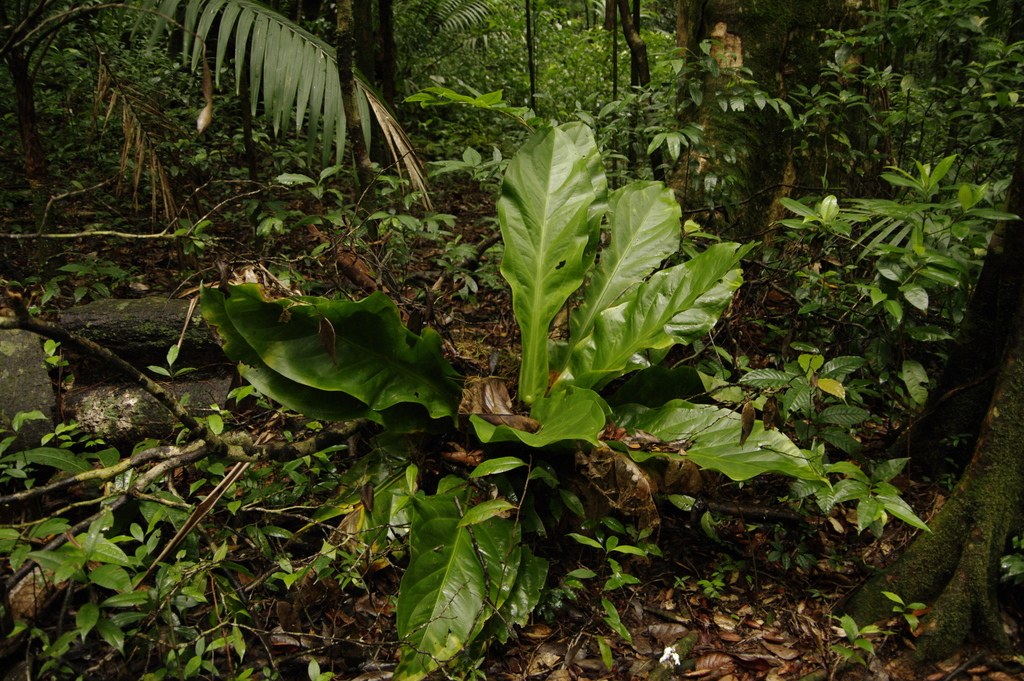
📷 Eric Knight / iNaturalist (CC BY 4.0)
Field Guide · Anthurium
The rosette anthuriums are quieter than the velvets, but the good ones reward a grower who reads them carefully.
The type species for the bird's-nest section. True hookeri has spatulate leaves with conspicuous black marginal glands along the edge and a stubby, often purple-tinged spadix that ripens to white berries. Wild plants form vase-like rosettes on trees throughout the Lesser Antilles and northern South America, catching leaf litter as a private compost heap. Most plants sold as hookeri in the trade are not — check for those black glands.
The typeA Central American giant that throws leathery, upright leaves over a meter long from a tight central crown. Tougher than hookeri in cultivation — it tolerates lower humidity, brighter light, and the kind of benign neglect that kills more delicate anthuriums. The infructescence is a long red-orange spike that holds for months. A good first bird's-nest if you want the form without the fuss.
Most forgivingBrazilian, and instantly recognizable by the ruffled, undulating leaf edges that read almost ribbon-like in good light. Forms a massive funnel as it ages and will outgrow most shelves within a few years. Often confused with superbum, but plowmanii leaves are flatter in cross-section and wave along the margin rather than folding down the midrib. Drought-tolerant once established.
Best shelf presenceEcuadorian, with leaves that fold sharply along the midrib into a stiff V and carry a bronze flush on new growth. Smaller and more compact than plowmanii, which makes it the practical choice for growers without a greenhouse. The undersides often show a faint reddish cast that's worth lighting from below if you can. Slow, but bulletproof once it settles.
Best for shelvesGuyana and Venezuela, and the parent of countless Indonesian hybrids — jenmanii × hookeri crosses dominate the Southeast Asian market. Pure jenmanii has broad, blunt-tipped leaves with a slightly leathery feel and a tidy, symmetrical rosette habit. Holds its form better than plowmanii in lower light. Provenance matters: ask sellers what they crossed it with.
Hybrid backbone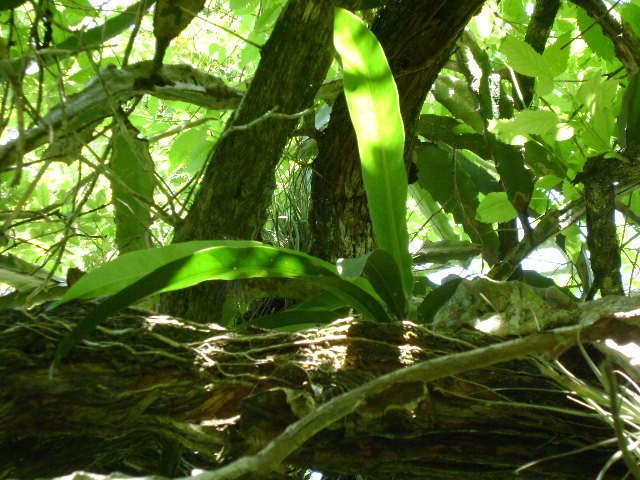
The rosette anthuriums evolved as litter-trappers. In habitat, hookeri and its relatives sit in tree crotches or on the forest floor with their leaves arranged in a tight funnel, catching falling debris that rots down into a private pocket of compost around the roots. Everything about their care follows from this. They want their crowns dry and their roots in something that behaves like decomposing leaf litter — chunky, airy, holding moisture without going anaerobic.
A mix I keep coming back to: roughly equal parts medium orchid bark, coarse perlite or pumice, and chunky coco husk, with maybe 15% by volume of a composted bark fines or worm castings for nutrition. Skip peat. Skip standard houseplant soil. If water doesn't run straight through the pot in two or three seconds, the mix is too fine. These are epiphytes and lithophytes with thick, white roots that rot fast in wet sludge.
Pot size matters less than people think. A bird's-nest anthurium will happily live in a pot that looks too small for its leaf spread, as long as the root mass fits and the medium drains. Net pots and slotted orchid pots work well. Terracotta is fine if you're a heavy waterer.
Bright indirect is the lazy answer; the honest one is that bird's-nest anthuriums take more light than the velvets. Schlechtendalii and plowmanii will color up beautifully in light strong enough to make a crystallinum bleach — think a meter back from an unobstructed east window, or directly under a decent LED at 150–250 µmol. Leaves grown in dim light come in floppy and pale and never quite firm up.
Water when the top inch of mix is dry and the pot feels light. In a chunky substrate that's usually every four to seven days indoors, longer in winter. Pour water through the medium, not into the crown — standing water in the rosette is the fastest route to bacterial rot, especially in still air. If your plant lives in a cabinet, tip it sideways now and then to drain the funnel.
Humidity above 60% is ideal but not required. Schlechtendalii, plowmanii, and jenmanii tolerate 45–50% without dropping leaf quality. Hookeri itself wants more — 65% and up if you want clean new growth. Airflow is non-negotiable at any humidity. A small clip fan moving air across the leaves prevents nearly every fungal problem these plants get.
Buying the wrong plant. Most hookeri in circulation is not hookeri. The diagnostic is the black marginal glands — tiny dark dots along the leaf edge, visible to the naked eye. No glands, not hookeri. It's likely jenmanii, a hybrid, or schlechtendalii sold under the wrong name. None of those are bad plants, but pay accordingly.
Treating them like velvets. Collectors coming from clarinervium and crystallinum tend to overwater rosette anthuriums and keep them too dim. The bird's-nests have thicker, more succulent roots and want a real wet-dry cycle. They sulk in the constant moisture that velvets enjoy.
Letting the crown sit wet. Water pooled in the funnel for more than a day, especially with poor airflow, will rot the growth point. If you mist or your humidifier drips into the rosette, blot it out or tilt the plant. A rotted crown on a mature plowmanii is heartbreaking and usually fatal.
Repotting too often. These plants resent root disturbance and grow slowly above ground even when roots are thriving. Repot every two to three years, in spring, and only when roots are circling the pot or the mix has broken down into mush. Otherwise, leave them alone.
The Field Guide from Leaf People.