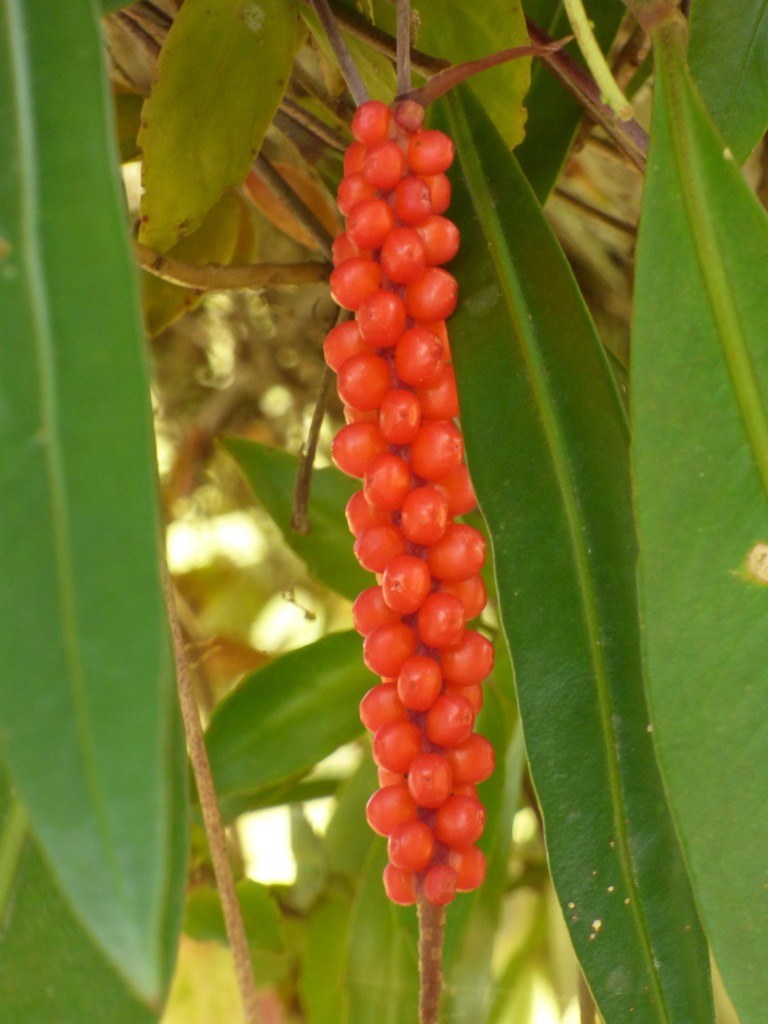
📷 Luis G Restrepo / iNaturalist (CC BY 4.0)
Field Guide · Anthurium
The strap-leaved epiphyte that trades showy foliage for a hanging rosary of translucent red fruit.
The reason you're here. A. gracile ranges across the Amazon basin and the Guianas, growing as a slim, pendent epiphyte with narrow, leathery leaves to about 40 cm. Its real performance is reproductive: a thin spadix matures into a string of glossy, near-translucent scarlet berries that hang for weeks. Easy to flower indoors once humidity and light are right.
The headlinerA close relative in section Pachyneurium's neighborhood, A. scandens climbs rather than dangles and produces clusters of white-to-lavender berries instead of red. It is small, tolerant, and one of the few anthuriums that genuinely thrives in a mixed terrarium. Flowers and fruits readily under modest light. A good gateway to the fruiting anthuriums.
Easiest fruiterPendent leaves can reach 60–90 cm, narrow and slightly undulate, with a long arching spadix that ripens to red berries similar to gracile but on a larger frame. Native to Central America and northern South America. Wants more room and more humidity than gracile, and rewards both. Often confused in trade with A. wendlingeri, which has the velvet pebbled texture friedrichsthalii lacks.
Bigger siblingCosta Rica and Panama, hanging from cloud-forest branches with deeply quilted, velvety pendent leaves and a corkscrew spadix that is a collector's piece in itself. Fruit ripens orange-red and persists. Demands real humidity (70%+) and stagnant-free airflow to keep the long leaves clean. Slower than gracile, and worth the wait.
Collector grailA tidy, mostly upright species from Central America with narrow leaves marked by faint purplish speckling on the underside. The spadix produces tight bunches of bright red berries held just above the foliage, more compact and stand-up than gracile's dangling strands. Tolerates lower humidity than most strap-leaved anthuriums. A sensible pick for shelf growers without a cabinet.
Best for shelves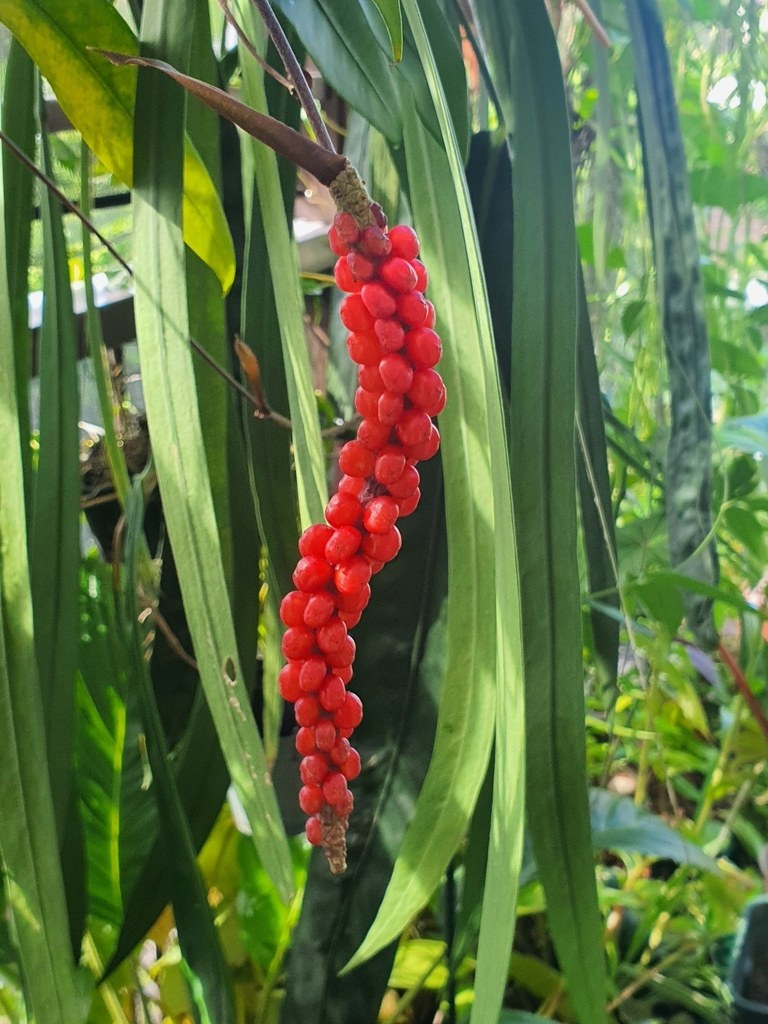
Anthurium gracile is an epiphyte first. In the wild it sits on branches with roots in moss, leaf litter, and air. Reproduce that and it thrives; pack it into peaty potting mix and it sulks, then rots.
A workable mix is roughly 40% medium orchid bark, 25% perlite or pumice, 20% chunky coco husk or coco chips, and 15% sphagnum to hold moisture against the roots. The mix should feel like a handful of mulch, not soil. In a 5-inch nursery pot with side slits, that combination dries in two to four days at room humidity, which is what you want.
Mounting is the alternative and arguably the better display for a pendent species. A slab of cork bark with a generous pad of long-fiber sphagnum at the base, the plant tied on with fishing line until roots grip, lets the leaves and fruiting spadix hang naturally. Mounted plants need daily misting or a humid cabinet — they dry fast — but you will see the berries the way they are meant to be seen.
Bright indirect light is the target: roughly 150–250 µmol/m²/s, or a spot a meter back from an unobstructed east window. Direct midday sun bleaches the straps and scorches the spadix. Too little light and the plant grows but will not flower, which defeats the whole point of owning a gracile.
Water when the top third of the substrate is dry to the touch. Strap-leaved anthuriums are more drought-tolerant than the velvet-leaved species, but their fine roots resent staying wet. Rainwater, distilled, or RO is strongly preferred — A. gracile shows tip burn from hard tap water within a few months. Fertilize lightly: a quarter-strength balanced liquid feed every second watering during active growth.
Humidity should sit above 60%, ideally 70–80% when the plant is in spike. Below 50% the spathe aborts and developing berries shrivel before they color up. Airflow matters as much as the number on the hygrometer; a small clip fan moving air across the leaves prevents the fungal spotting that humid-cabinet anthuriums are prone to.
The fruiting display is not difficult once the basics are right. A. gracile is self-fertile, and a mature plant in good light will set berries from its own pollen without intervention. If you want to improve set, use a small brush to move pollen along the spadix when it turns powdery, then wait. Berries take four to seven months to ripen from green to that signature glassy red, and they hang on the spadix for weeks once colored.
The most common mistake is treating it like a standard Anthurium andraeanum hybrid from the garden center — heavy peaty mix, frequent watering, a saucer of standing water. The roots suffocate, the lower leaves yellow, and the plant declines over a season. The second mistake is impatience with flowering: a young plant grown from a division or seedling may need two to three years of steady growth before it spikes. Give it light, leave it alone, and it will perform.
One more: do not cut the spadix once berries form, even if it looks ragged. The ripening process is slow, the visual payoff is the entire reason for the species, and a healthy plant will push a new spike alongside the old one. A well-grown gracile often carries two generations of fruit at once — half-ripe green strand below, fully red rosary above. That is the picture worth keeping the plant for.
The Field Guide from Leaf People.