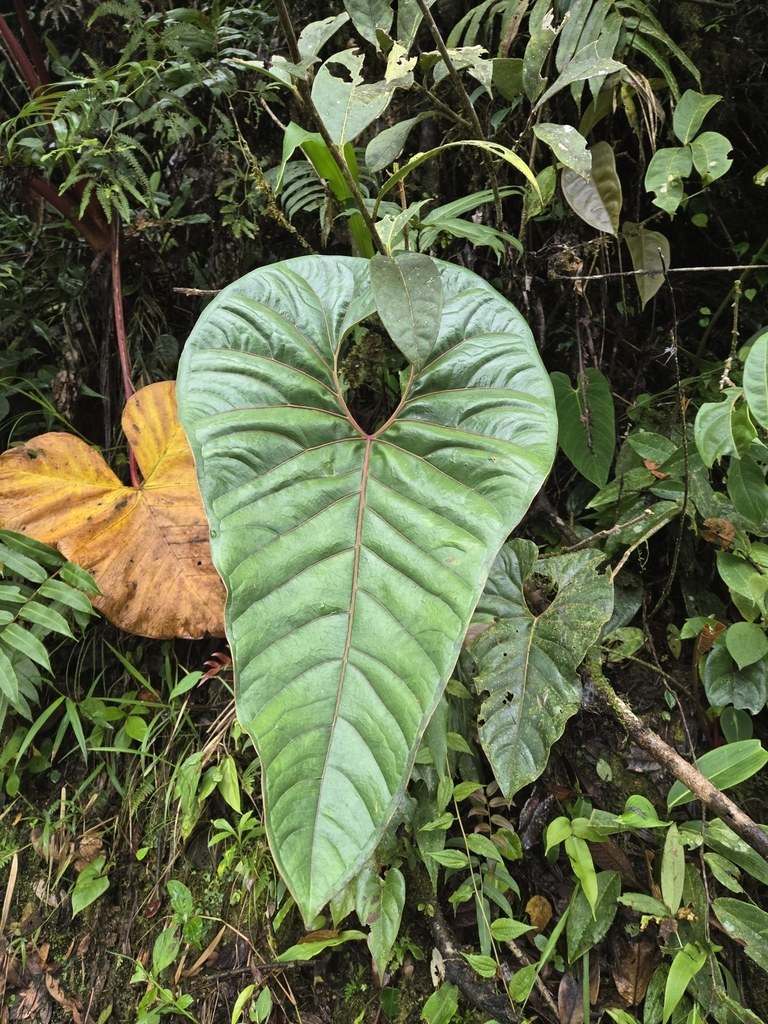
📷 RJ Baltierra / iNaturalist (CC BY 4.0)
Field Guide · Anthurium
The section Cardiolonchium gets the velvet press, but the strap-leaved giants are where Anthurium grows up.
A Colombian and Ecuadorian lowland species with thick, drooping, ribbed leaves that can pass a meter on a mature plant. The blade is leathery rather than velvety, with a prominent midrib and a long, tapering tip that hangs like a sword. It's slow to size up but exceptionally hardy once established, tolerating warm rooms that would scorch a crystallinum. A genuinely architectural plant when given the floor space it deserves.
The headlinerA bird's-nest type from Central and South American wet forests with broad, pendulous, paddle-shaped leaves arranged in a tight rosette. It grows outward and downward rather than upward, which makes it a natural mounted specimen or basket subject. Leaves are mid-green, faintly bullate, and far more humidity-forgiving than the velvet anthuriums. Easy to keep, hard to find well-grown.
Best mountedThe classic bird's-nest anthurium from the Guianas and northern Brazil, with stiff, glossy, paddle-shaped leaves radiating from a central crown. Tougher than almost anything else in the genus — it shrugs off household humidity and irregular watering that would finish a thin-leaved species. Hybridizers love it for exactly that reason, but the straight species is handsome on its own. A good first big-leaf anthurium.
Most forgivingA Venezuelan species with narrow, ribbed, deeply pendulous leaves that can exceed a meter on a mature epiphyte. The midrib is heavy and the blade quilts slightly along the secondary veins, giving the whole plant a sculpted look. It wants more humidity than jenmanii but rewards it with dramatic length. Grow it high and let the leaves fall.
For tall spacesA widespread Mesoamerican species with broad, leathery, paddle leaves and a stout rhizome that can root into almost anything. It's reportedly used medicinally across parts of its native range, which tells you something about how common and robust it is. Tolerates lower humidity, brighter light, and cooler nights than most aroid collectors will throw at it. A workhorse, in the best sense.
Toughest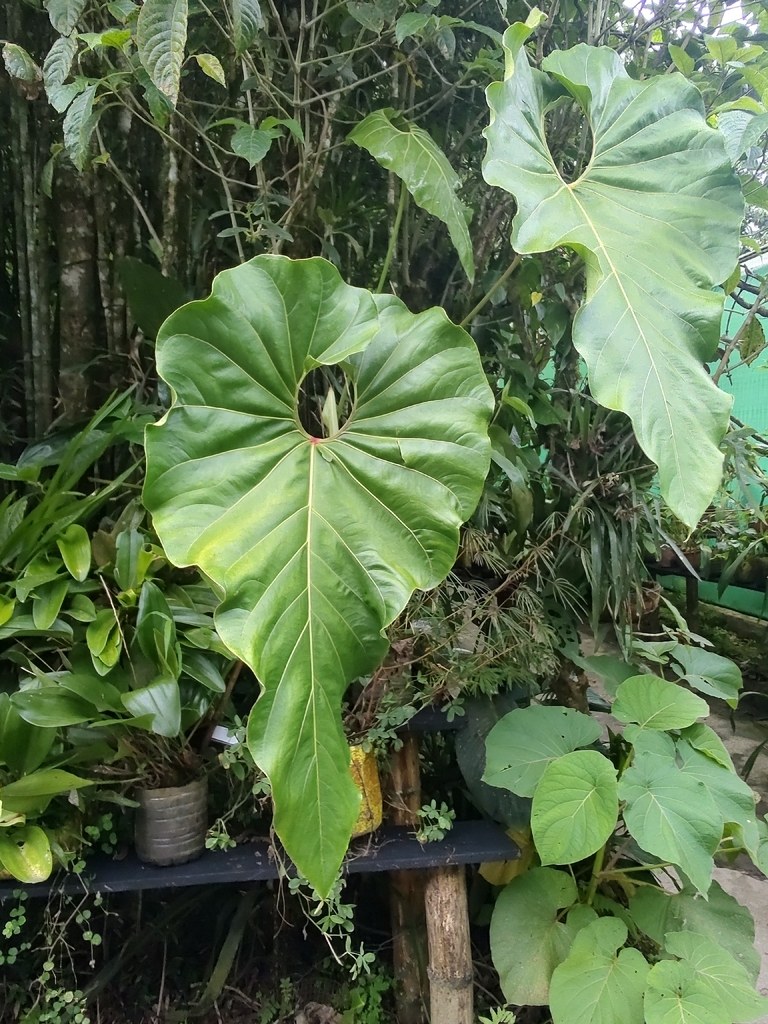
The large simple-leaf anthuriums — section Pachyneurium and a handful of relatives — are the ones that look like nothing else in the genus. No deeply lobed polydactylum hand, no velvet crystallinum heart, no warocqueanum pendant tongue. Instead you get a single, undivided blade: strap, paddle, or sword, often a meter or more long, often ribbed along the secondary veins, often arranged in a loose rosette around a thickening rhizome.
Anthurium decipiens is the species I keep returning to. It's not rare in cultivation, but a well-grown one is uncommon, because most people treat it like a velvet anthurium and stall it out. Decipiens is a lowland plant. It wants warmth, it wants air at the roots, and it wants to be left alone to extend leaves on its own clock. Push it and you get edge burn. Coddle it in a sealed cabinet and you get rot at the petiole base.
Every large simple-leaf anthurium I grow lives in a chunky, mostly-bark mix. My working recipe for decipiens is roughly 60% medium orchid bark, 20% perlite or pumice, 10% coarse charcoal, 10% chopped sphagnum for a little moisture retention. The goal is a mix that drains within seconds of watering and dries from the top down over four to seven days.
These plants have thick, fleshy roots that resent staying wet against fine particles. If you've been growing velvet anthuriums in sphagnum-heavy mixes and want to add a decipiens or jenmanii, do not reuse that recipe. Pot into something you'd be comfortable using for a Stanhopea. A net pot or a wide, shallow terracotta bowl beats a tall plastic cylinder — the rhizome wants to creep, not dive.
Repot only when the mix breaks down or roots have genuinely filled the container. These are not plants that appreciate annual disturbance. I've left a healthy schlechtendalii in the same bark for three years and watched it double in size.
Bright indirect light, with an hour or two of gentle direct sun acceptable on the eastern side of a window. The leathery blade tolerates more light than a velvet species but burns just as readily under unfiltered midday glass. If new leaves are coming in smaller and paler than the last, give more light, not less.
Water deeply, then let the top third of the mix dry. With a bark-heavy substrate in a warm room this usually lands at every four to six days; in cooler months, stretch it. These species store water in their petioles and rhizome and recover from underwatering far better than from a soggy week. Tap water is generally fine if your TDS is reasonable; they're not Anthurium luxurians, fussing over minerals.
Humidity above 60% is ideal, but jenmanii, schlechtendalii, and a well-rooted decipiens will hold form down to 45–50% if airflow is good and roots are healthy. Stagnant high humidity is worse than moderate humidity with a fan running. The single most useful piece of equipment in my anthurium room is a small clip fan on a timer, not the humidifier.
The first mistake is treating these like velvets. Simple-leaf species want more light, more air, and less moisture at the roots than crystallinum or magnificum. If you've migrated from velvets, dial everything back toward an orchid's conditions.
The second is impatience. A new decipiens leaf can take eight to twelve weeks to harden off from cataphyll to full extension, and the plant may only push two or three leaves a year as a juvenile. Feeding harder doesn't speed it up; it just burns root tips. Use a dilute balanced fertilizer at roughly a quarter strength with most waterings and stop chasing growth.
The third is pot shape. Tall narrow nursery pots trap water at the base, where the rhizome sits. A shallow, wide pot — clay, wood, or a basket — matches the plant's habit and keeps the crown above wet media. This one change has saved more anthuriums in my collection than any humidifier ever did.
The Field Guide from Leaf People.