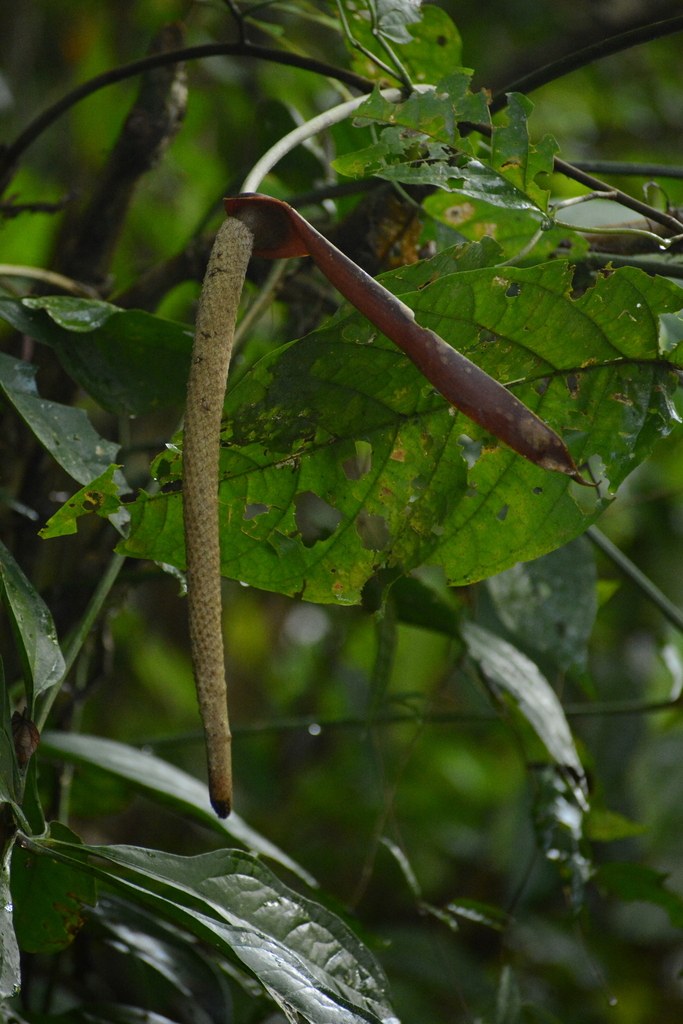
📷 Siddarth Machado / iNaturalist (CC BY 4.0)
Field Guide · Anthurium
A canopy-bound hemiepiphyte with palmate leaves the size of a coffee table — and the appetites to match.
The headliner: a Central and South American climber whose mature leaves split into 7–13 deep finger-like lobes radiating from a long petiole. Juveniles look almost ordinary — entire, heart-shaped — and the transformation only begins once the plant climbs and roots into bark or moss. Expect aerial roots thicker than a pencil and petioles over a meter on settled specimens. It is not subtle, and it is not small.
The headlinerOften confused with clavigerum in juvenile photos, but pentaphyllum has truly compound leaves — five to seven separate leaflets attached at a single point, not a single lobed blade. It stays manageable indoors and tolerates slightly lower humidity than its giant cousin. A good gateway into the palmate-leaf anthuriums for collectors short on ceiling height. Native from Mexico south through Brazil.
Smaller stand-inThe fine-boned version of the palmate group, with narrow, almost grass-like leaflets arranged like spokes. It climbs willingly on a moss pole and matures faster than clavigerum, rewarding patience on a scale of seasons rather than years. Light feeder, prefers airy substrate, and sulks if kept wet. Native to the western Amazon basin.
Compact climberA Mexican species with enormous, deeply pinnatifid leaves on long petioles — closer in feel to a giant fern than the typical anthurium. Unlike clavigerum, it grows from a stout terrestrial rhizome and does not climb, which makes it easier to accommodate in a normal room. Cool-tolerant and forgiving by anthurium standards.
Floor-dweller alternative
Anthurium clavigerum is a hemiepiphyte. It germinates on the forest floor, finds a tree, climbs, and only develops its adult leaf form once it has rooted high into bark and accumulated organic debris around its stem. In the wild, mature plants in Panama, Colombia, Ecuador, and across the western Amazon carry leaves that can exceed five feet across, held on petioles longer than your arm.
The practical consequence for growers is simple: a clavigerum kept on a short pole or a small slab will stay a juvenile forever. The entire, heart-shaped early leaves are pleasant enough, but the famous palmate adult form requires height, contact between aerial roots and a damp climbing surface, and consistent warmth. Plan for a totem at least 5–6 feet tall, ideally a thick slab of cork or a stuffed moss pole you can keep wet from the top down.
Temperature matters more than people admit. The species comes from warm lowland and pre-montane forest and stalls below about 65°F. Cold drafts in winter are the most common reason a healthy import refuses to push new leaves for six months.
Use a chunky, structural mix. A workable blend is roughly 40% medium orchid bark, 20% perlite or pumice, 20% coco chunks or tree fern fiber, and 20% high-quality sphagnum to hold moisture against the roots. The mix should drain freely the moment you pour water through it, and it should still feel cool and damp — not soggy — two days later. Solid peat-based houseplant soil will rot a clavigerum within a season.
Water when the top inch of the mix is just dry to the touch. This is a thirsty plant when actively growing — those huge leaves transpire heavily — but the roots are thick, fleshy, and rot fast in stagnant wet. Watering deeply and then allowing real airflow through the pot beats frequent shallow sips.
Humidity should stay above 70% for adult leaves to expand cleanly without edge damage. Below 60%, expect crisped margins and slower lobing. A grow tent, an enclosed atrium, or a humidified plant room is realistic; a living-room corner with a small humidifier usually is not. Pair humidity with moving air — a quiet clip fan on low — to prevent the bacterial leaf spotting anthuriums are prone to in still, wet conditions.
Bright indirect light, full stop. Clavigerum in cultivation does well at roughly 200–400 µmol/m²/s PPFD, which translates to a few feet from a strong east window or under a decent LED running 10–12 hours. Direct midday sun bleaches the blade and scorches the lobes; deep shade produces small, undivided leaves and weak petioles that flop.
Feed lightly and constantly rather than heavily and occasionally. A balanced liquid fertilizer at quarter strength with every other watering keeps the plant pushing. Top-dress the pole with a thin layer of worm castings once a season if you want to see what this species can really do.
The mistakes that kill clavigerum are predictable. People pot it in dense soil and drown the roots. They give it a 3-foot moss pole and wonder why it never lobes. They let humidity crash in winter and watch new leaves emerge deformed. They buy a tiny seedling expecting adult leaves in a year — this is a plant that rewards a five-year commitment, not a season.
The Field Guide from Leaf People.